Home / Locations
Serving California • 2,084 ZIP Codes CoveredWater Damage Restoration Near Me in California: One Call, a Local Crew, a Dry Home
When water is coming in, a water damage restoration near me search is really a search for one thing: a crew that will actually come, quickly, to your address. Water Damage Pros is a California company that takes that call and matches it by ZIP code with an independent local crew. Seven city guides are published, 2,084 ZIP codes are covered, and the matching works the same way whether your town has a guide yet or not.
One call to Water Damage Pros matches your address with an independent local crew anywhere in the company's California coverage: 2,084 ZIP codes, 40 counties, 864 communities. Seven city guides are published now; if your town has no guide yet, the call still reaches the nearest crew. Extraction first, meter-checked drying behind it, repairs after the structure tests dry.
Water Damage Restoration Near Me: 7 City Guides, Each Written for Its Own Homes
Every city on this page has its own full guide, because water damage never looks the same twice. Slab leaks rule the postwar suburbs, hillside runoff rules the canyons, and creek flooding rules the valley floors. Pick your city below for the guide written for its homes, or call and the company will match you by ZIP code either way. New guides are published in order of demand, starting with the cities where the most homeowners search for help, so the list below grows in the order that matters most.
San Diego
Slab leaks in the 1950s to 1980s suburbs from Clairemont to Rancho Bernardo, Mission Valley flooding, and drywall drying decisions. 79 ZIP codes.
Los Angeles
Galvanized pipe failures in pre-war homes, hillside storm runoff, Los Angeles River flooding, and postwar Valley slab tracts. 137 ZIP codes.
Glendale
Cast iron and clay pipe failures in 1920s to 1940s neighborhoods, canyon runoff, and shared sewer laterals. 14 ZIP codes.
Anaheim
Slab leaks and pinhole copper lines in postwar West Anaheim, upstairs leaks in Anaheim Hills, and slab-leak insurance claims. 15 ZIP codes.
Lancaster
High-desert slab tracts, evaporative cooler roof leaks, winter freeze bursts, and monsoon runoff over hard ground. 5 ZIP codes.
San Jose
Coyote Creek and Guadalupe River storm water, the February 2017 flood, and old pipes in Willow Glen and the Rose Garden. 54 ZIP codes.
Santa Clarita
Upstairs leaks in two-story tracts, slab lines, AC condensate failures, and Santa Clara River storm water. 6 ZIP codes.
More cities are coming. If yours is not listed yet, the call still works: matching runs on ZIP codes, not on published guides.
Water Damage Restoration Locations: All 40 Counties, One Number
These water damage restoration locations cover every county where the company matches calls, from Del Norte on the Oregon line to San Diego on the Mexican border. The list below names all 40; the matching itself runs on ZIP codes, so a county line never decides whether help reaches you.
Los Angeles County holds the largest crew pool, with 131 communities in the company's coverage, followed by San Bernardino, Orange, Riverside and San Diego counties. Smaller counties have fewer crews but the same process: one call, a ZIP code match, a local crew. A county with a single covered community still gets a crew matched to it, because the match is made by address, not by how many neighbors share the county.
Rural and mountain coverage works the same way, with one honest difference: drive time. A home in the Sierra foothills or a desert community outside the metro edge is matched from the nearest town with a crew, which can mean a longer wait than a city call. The process does not change and the crew does not change; only the road does. The same applies on the coast range and in the far north, where a single storm can close the only road in. If the drive will be long, the call says so up front, so you can plan around it instead of wondering.
A Water Damage Restoration Company California Homeowners Can Call
One thing, stated plainly: Water Damage Pros is a California company, not the service provider that dries your home. The company takes your call and matches it by ZIP code; the independent local contractor who arrives does the work. The company address, phone and email are in the footer of every page. That matters when something goes wrong with a job: you know exactly which company took your call, and the contractor who did the work is a separate, identifiable business. No crew is dispatched without a call, and no call is answered by a machine pretending to be local.
How One Call Becomes a Crew at Your Door
The process has four steps and no forms, no waiting room, no call-back queue. You call, the company matches your address, a crew comes, and the work follows the same order on every job: water out, structure dry, repairs last. Here is what happens at each step, so you know what to expect before you dial.
You call
Tell the company your address and ZIP code, where the water came from, whether it is still coming in, and which rooms are wet. Four facts are enough to start the match.
The match
Your ZIP code is checked against the coverage map and the nearest available independent crew is matched to your address. You are told honestly what the timing looks like for your area.
The crew arrives
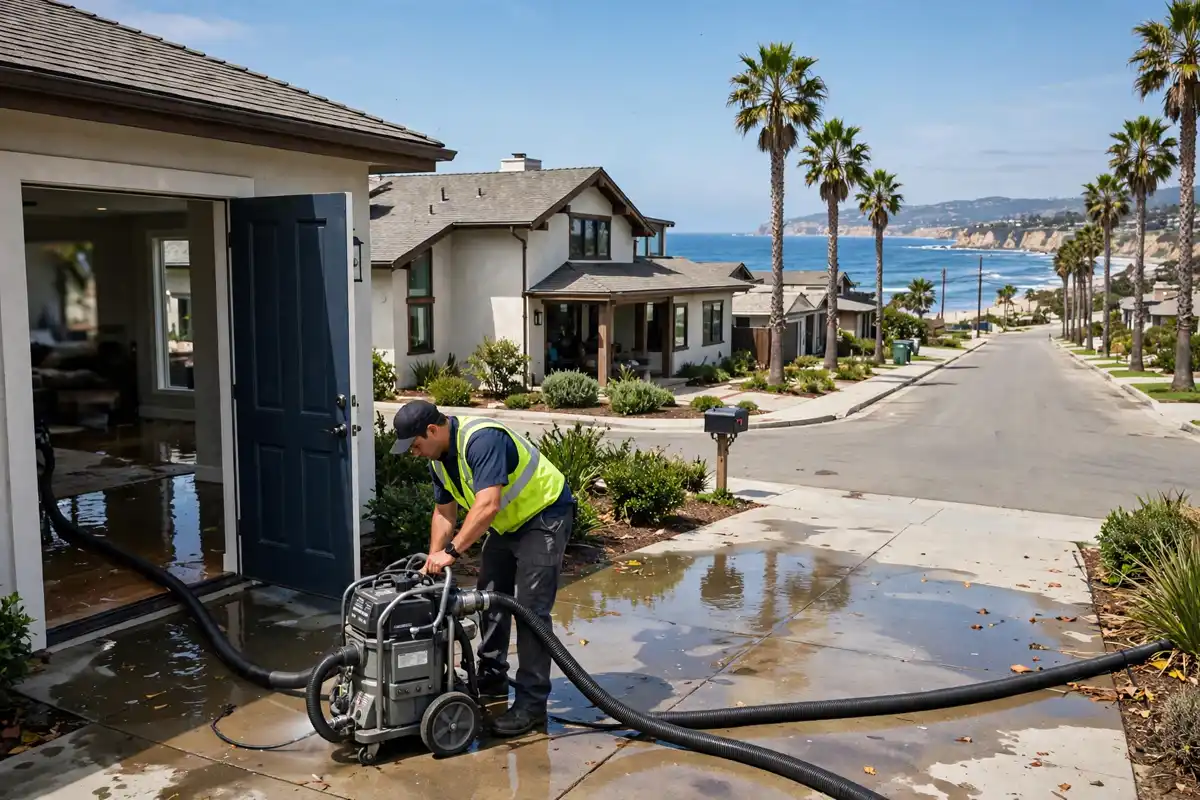
Extraction comes first: standing water out with truck-mounted or portable extractors, wet materials assessed, and the drying plan set before anything is torn out.
Drying, verified
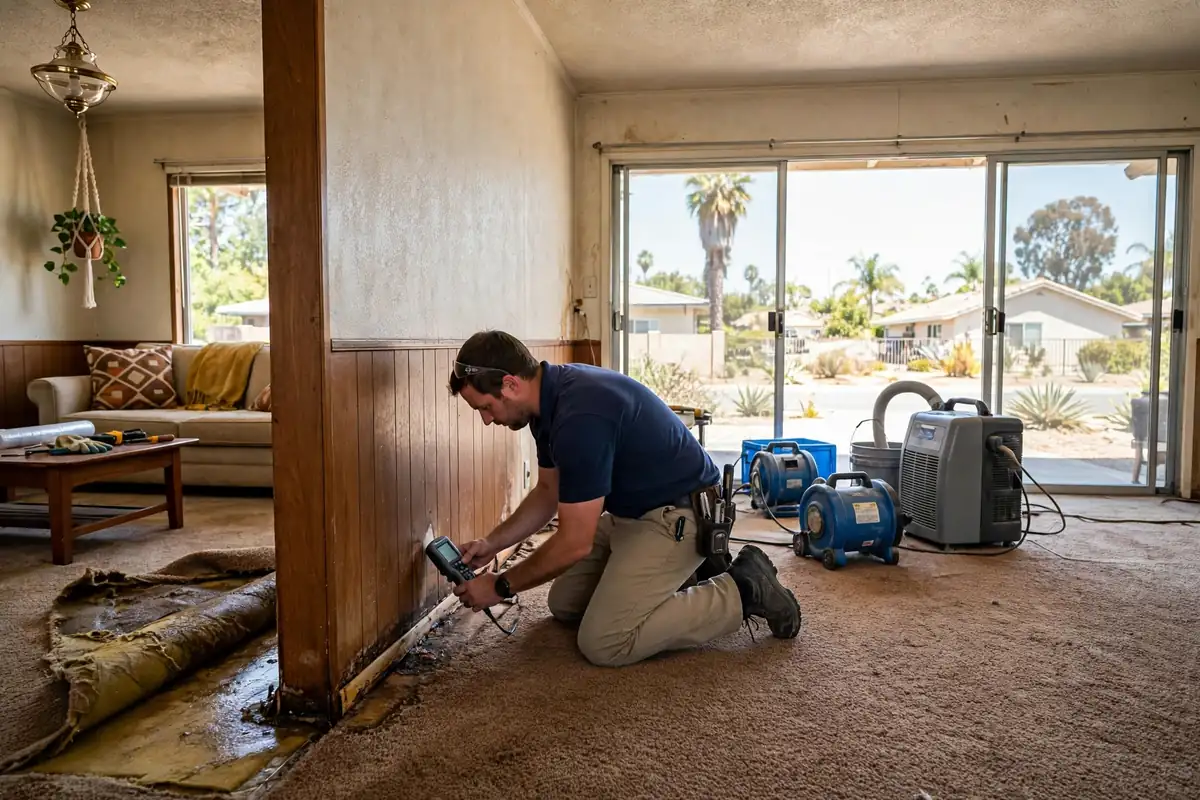
Air movers and dehumidifiers run for days, not hours, and moisture meters decide when the structure is dry. Repairs start only after the readings say so.
While you wait for the crew, shut the water off at the main if the source is a pipe, keep clear of rooms where water meets electrical outlets or appliances, and take photos of everything before anything moves. Those photos matter twice: they help the crew plan the job, and they are the backbone of any insurance claim. If the water is still coming in, say so first on the call; a live leak jumps the queue ahead of water that has already stopped.
The crew brings its own equipment, so there is nothing to buy or prepare before they arrive. Truck-mounted or portable extractors for standing water, moisture meters and thermal cameras for finding wet spots inside walls, air movers and dehumidifiers for the drying days, and containment sheeting when a room needs to be dried apart from the rest of the house. What you can do is clear a path: move small valuables out of the wet rooms, lift curtains off the floor, and leave heavy furniture where it is. Moving a waterlogged sofa alone is how backs get hurt; the crew handles the heavy work.
Six Water Problems, One Number to Call
Six kinds of water damage cover almost every call the company takes. Each one has its own process, its own risks, and its own section in your city guide. If your problem is not on this list, call anyway: the match is made by what happened, not by a menu.
Water Extraction & Standing Water Removal
Truck-mounted and portable extractors pull standing water out of floors, carpets and padding before drying takes over. The first hours decide the size of the whole job.
Burst Pipe Water Damage
A supply line lets go and a home takes on water by the gallon per minute. Source stopped, water out, structure dried, in that order.
Sewage Backup Cleanup
A sewage backup is a biohazard, not a mopping job. Contaminated materials come out, hard surfaces are disinfected, and the crew works protected.
Flood & Storm Water Cleanup
Atmospheric rivers, river flooding and post-fire debris flows bring silt and contamination with them. Pumping out, mucking out, disinfecting and drying, in that order.
Structural Drying & Dehumidification
Extraction removes the water you can see. Drying removes the moisture inside walls, floors and framing, verified by daily meter readings against a dry standard.
Mold After Water Damage
Mold can begin on wet materials within 24 to 48 hours. Fast extraction and verified drying are what keep a water job from becoming a mold job.
Why Does California Water Damage Look Different From Any Other State?
California is not one water market. It is a desert, a coastline, a mountain range and the most built-up farmland on earth, sharing one state line. The water that ruins a home in Lancaster has almost nothing in common with the water that ruins one in San Jose, and the crews, the drying plans and the insurance fights differ with them. Three patterns explain most of it.
Winter Storms Do Most of the Damage
Most California water damage arrives between December and March, when atmospheric river storms push Pacific moisture into the state in concentrated bands. A single storm can drop a month of rain in three days, and it does not fall evenly: coastal ranges wring out the clouds first, valley floors collect the runoff, and burn scars from summer wildfires shed water like pavement. The launch cities all peak in the same window, which is why crews are busiest in winter and why a December call can mean a longer wait than an April one. Summer is the quiet season for storms but not for water damage: air conditioning condensate lines clog, irrigation lines split, and evaporative coolers leak through ceilings in the high desert. The work never stops; only the cause changes.
Storm water gets inside in ways a homeowner rarely expects. Roof leaks show up two rooms away from the failed flashing, because water runs along rafters before it drips. Window seals fail under wind-driven rain even when the roof is sound. Ground floors flood from water that never entered through a door: it comes up through slab cracks, through the garage, or through a window well that filled like a bucket. Garages pool first and basements, where they exist, fill last and drain slowest. A crew that has worked the same storm pattern for years checks all of these before declaring a room dry, because the water you cannot see is the water that grows mold.
Slab Homes and Old Pipes Fail in Different Ways
California's housing was built in waves, and each wave fails on its own schedule. The 1920s to 1940s homes of Glendale and the older Los Angeles neighborhoods run galvanized steel and cast iron that corrode from the inside, narrowing until a joint gives way. The postwar boom of the 1950s to 1980s poured slab foundations across San Diego, the San Fernando Valley and the Inland Empire, with copper supply lines buried in the concrete; those lines develop pinhole leaks that soak the slab for weeks before anyone notices a warm floor or a rising bill. The master-planned tracts of the 1990s and 2000s run plastic supply lines through two-story walls, so their failures show up as upstairs bathroom leaks raining into living rooms. A crew that knows which era your home belongs to already knows where to look first, which is the whole point of a local match.
The first check differs by era, and it saves hours when it is right. In a slab home the crew looks for a warm patch on the floor, listens at the slab with an acoustic device, and watches the water meter with everything off: a spinning meter means a live leak under the concrete. In a pre-war home the checks are water pressure at the tap, discoloration in the first drawn water, and the condition of exposed joints in the basement or crawl space. In a two-story tract the crew starts upstairs, at the bathrooms and the AC condensate line, because gravity does the rest of the diagnosis for free. None of this needs the homeowner to know the era; the address and the year the home was built are enough for the crew to bring the right tools.
Insurance Rewards the Fast Call
Homeowners insurance usually covers sudden and accidental water damage: a burst pipe, a failed water heater, a storm-driven roof leak. It usually does not cover slow leaks that went on for weeks, or rising flood water, which needs a separate flood policy with a 30-day waiting period before it takes effect. The difference between a covered claim and a denied one is often documentation made in the first hours: photos before anything moves, moisture readings from the crew, and a written scope of the work. Fast calls produce all three; slow calls produce arguments. The company does not sell insurance and does not promise claim outcomes, but every crew it matches is expected to document the job as if a claim depends on it, because it usually does.
Good documentation has four parts, and all four are free. Photograph every wet room before anything is moved, with a timestamp on the photos. Keep the crew's moisture readings and the written scope of work in one place. Save every receipt, from the plumber who stopped the leak to the hotel if the home is uninhabitable. Call the insurer the same day, even if the claim is filed later, because a same-day report is hard to argue with. Claims fail most often not on the damage but on the record of it, and the record is made in the first hours, while the water is still on the floor.
Questions About Coverage, Matching and the First Call
My town is not listed. Can you still help?
Yes. The seven city guides cover the largest launch cities, but matching runs on ZIP codes across 2,084 of them in 40 counties. Call with the property address and the company will match the nearest independent crew, whether or not your town has a published guide yet. New guides are added by demand, so a town with no guide today may have one soon; the call works the same either way.
How fast can a crew reach my home?
In the launch cities most calls are answered with a crew the same day, often within hours. Rural and mountain addresses can take longer, and you will be told honestly on the call what the timing looks like for your ZIP code. A live leak is prioritized over water that has already stopped, so say so first if the water is still coming in.
How do I know my ZIP code is covered?
The company covers 2,084 ZIP codes in 864 communities. The call confirms your exact address against the coverage map, so you get a straight answer in minutes. County lines never decide coverage; your ZIP code does. If your address sits on a county edge, that changes nothing: the match is made by address, not by which side of a line you fall on.
What happens when I call?
A coordinator takes your address and ZIP code, where the water came from, whether it is still coming in, and which rooms are wet. That is enough to match the nearest available independent crew, who calls ahead before arriving. Extraction starts the job; meter-checked drying decides when it is done. You will know the crew is coming before it arrives, and you will know the drying plan before anything is torn out.
Are the crews employed by Water Damage Pros?
No. The crews are independent local contractors. Water Damage Pros is the California company that takes your call and matches it by ZIP code; the contractor who arrives does the work. The company address, phone and email are in the footer of every page. It is the homeowner's responsibility to verify that the hired contractor furnishes the necessary license and insurance for the work being performed.
What will the job cost?
This site does not publish prices, because every job differs: the size of the wet area, the materials involved, and how long the water sat all change the scope. The crew scopes the job on site and explains the work before anything starts. No payment is taken on the call, and no work begins until you understand what the crew plans to do and why.
Water in the House Right Now?
The fastest way to end a water damage restoration near me search is one call. Tell the company your address and what happened; a local crew is matched by ZIP code, extraction starts the job, and meter-checked drying decides when it is done.