Water Damage Restoration San Jose, CA: Creek Water, Old Pipes and Wet Hardwood, Dried Right
In San Jose, water trouble comes from two directions. Inside, the pre-war homes of Willow Glen and the Rose Garden hide century-old pipes, and the slab tracts of Cambrian and Blossom Valley hide theirs under concrete. Outside, Coyote Creek and the Guadalupe River remind the low streets what a hard storm can do. Homeowners looking for water damage restoration in San Jose call one number here and get matched with an independent local crew that knows both patterns: extraction first, meter-checked drying behind it, and repairs scoped in writing. One call, one local crew, one job done in the right order.
What To Tell Us When You Call
Four details that help the crew matched to your call bring the right equipment sooner.
📞 (833) 555-0100Street address and ZIP code, so the crew closest to your neighborhood heads out to you.
A burst pipe, a water heater, an appliance, the roof, a sewer line, or creek and storm water through a door.
If water is still flowing, stay on the line: we will talk you through shutting it off.
The rooms affected, whether floors, walls or ceilings are wet, and how long it has been.
If you have standing water in a San Jose home: shut off the water at the main if it is safe, keep clear of wet outlets, take photos and video for your insurer, and call (833) 555-0100 to be matched with a local crew. Most San Jose water damage calls start exactly this way. For standing-water removal, the first day matters most: extraction and drying started within 24 hours can save hardwood, plaster and original trim that a weekend of waiting loses to swelling and mold. If creek water is rising on your street, get people and pets out first; never wade through moving water.
Water Damage Restoration San Jose Crews Read Like Locals, Because They Are
San Jose water damage follows the creeks and the building era. Historic neighborhoods hide aging pipes inside plaster and lath, postwar tracts sit on slabs, and the streets near Coyote Creek and the Guadalupe River take storm water the drains cannot move fast enough. A local crew reads all three patterns on sight.
Start with the old neighborhoods. Willow Glen, the Rose Garden, Japantown and Naglee Park were built largely before 1940, plumbed with galvanized steel and drained by cast iron and clay. Most are at or past their working life now, and the failures are quiet ones: pressure fades, drains slow, and by the time a stain blooms the wall cavity has been wet for weeks.
Then there is the water outside. Coyote Creek runs down the east side of the city and the Guadalupe River through the center, and in a hard storm they and the storm drains behind them decide which streets flood. February 2017 proved it, when Coyote Creek put whole blocks of the center under water. Ground-floor rooms, garages and creek-side lots take it first, carrying silt and street contamination.
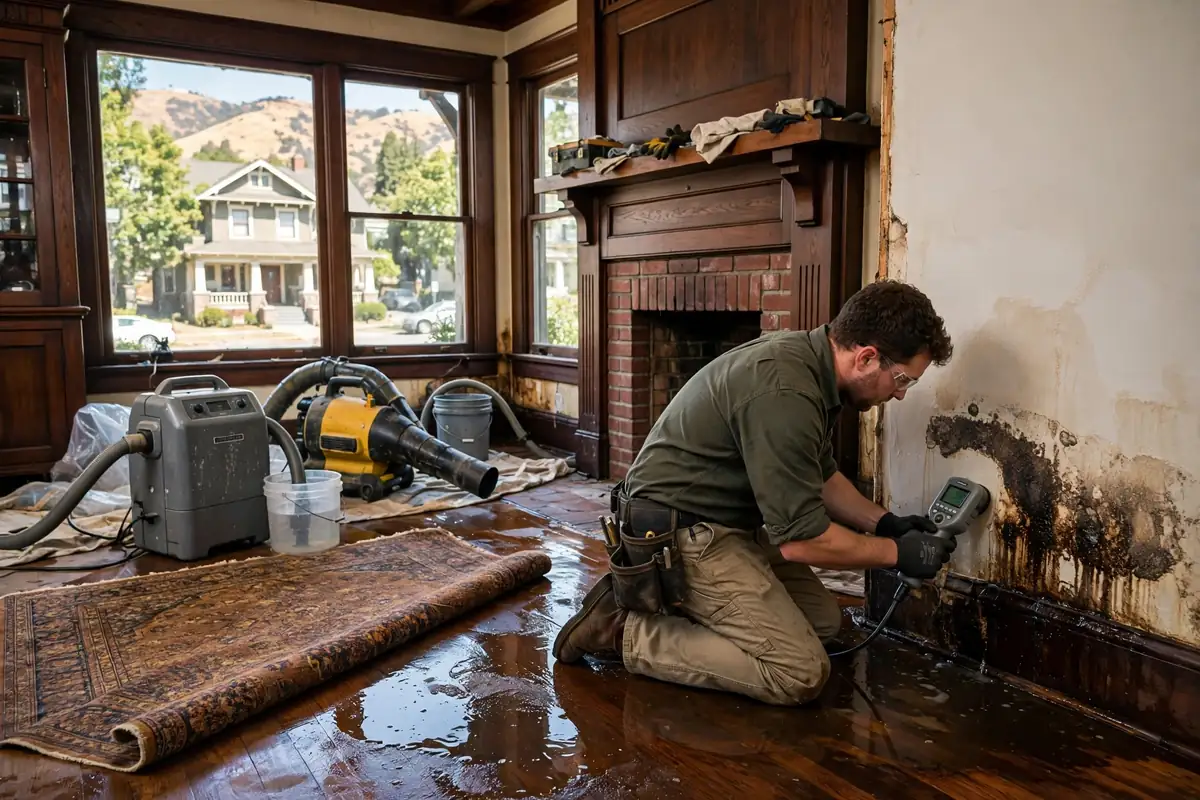
Willow Glen and Rose Garden Homes
Galvanized lines, cast iron drains, plaster walls, and original hardwood that cups when a slow leak runs.
Creek and Low-Street Homes
Rock Springs and the streets along both waterways. Storm water, silt, and drains that back up when the creeks run high.
Slab and Two-Story Tracts
Cambrian, Blossom Valley, Berryessa and Evergreen. Slab lines under postwar floors, upstairs bathrooms over kitchens, and foothill drainage in the east.
One thing, stated plainly: Water Damage Pros is a California company, not the service provider that dries your home. The company takes your call and matches it by ZIP code; the independent local contractor who arrives does the work. The company address, phone and email are in the footer of every page.
What Should You Do in the First Hour After Water Gets In?
San Jose's creek flooding and older neighborhoods make the first hour a race against rising water. Work this list in order, and only where it is safe.
Stop the source
If a pipe or appliance is behind it, turn the water off at the main shutoff, usually at the front of the property or beside the garage. In Willow Glen and Rose Garden, old supply lines can split without warning, so shut the water off at the first sign of a wet wall. For creek storm water, stay out of the flow and wait for the water to stop rising.
Kill power to wet rooms
Switch off the breaker for any room where water is near outlets, appliances or the panel. Never step into standing water that may be electrified. Ground-floor rooms near the creeks flood first, so switch off the lowest rooms even if the water has not reached them yet.
Photograph everything
Rooms, walls, floors, belongings, and the water line on the wall, inside and outside. Insurers pay on records, not memories, and photos taken before cleanup are the strongest record. Photograph the outside water line too, since creek flooding is judged by how high the water rose.
Move what you safely can
Documents, electronics and furniture legs out of the water, starting with the lowest items. Move items off ground-floor floors first, since creek water rises from the lowest point. Do not throw damaged items away until your insurer has documented them.
Start extraction fast
Every hour of standing water is more plaster, flooring and framing that will not come back. Call (833) 555-0100: an early call gets a local crew moving while damage is still small, and creek water carries silt that sets fast if it is left to dry in place.
Why Does Storm Water Keep Finding San Jose Homes?
Two waterways cross the city, Coyote Creek on the east side and the Guadalupe River through the center, and a hard storm can push both past what the drains were built to move. The homes that flood are rarely random: they sit low, near a creek, or at the bottom of a street the drains serve last.
Crews read the same pattern of clues:
- Debris and silt lines on fences and garage doors after past storms
- Street storm drains that bubble back during heavy rain
- Ground floors and garages that sit below street level
- Soil that stays saturated along creek-side and low lots for days
- Wall bases that smell musty every winter on the same streets
The split of work matters here: creek levels and city drains belong to the city and the water district; your lot drainage, door thresholds and shutoffs belong to you. The restoration crew handles what the water did once it got in: extraction, disinfection where creek water carried contamination, drying to a verified standard, and the repairs. One call to (833) 555-0100 starts that work, and the crew's records become your claim file.
Which Water Problems Can One Call Handle in San Jose?
Six kinds of water damage cover almost every San Jose water damage call. Each has its own process and risks.
Water Extraction and Standing Water Removal
Truck-mounted and portable extractors pull standing water out of floors and carpets before drying takes over. The first hours decide the size of the job.
Burst Pipe Water Damage
A supply line lets go and a room takes on water by the gallon per minute. Source stopped, water out, structure dried.
Sewage Backup Cleanup
A sewage backup is a biohazard, not a mopping job. Contaminated materials come out, surfaces are disinfected, and the crew works protected.
Flood and Storm Water Cleanup
Creek overflows, backed-up storm drains and wind-driven rain bring silt and contamination with them. Pumping out, disinfecting and drying, in that order.
Structural Drying and Dehumidification
Extraction removes the water you can see. Drying removes moisture inside walls, floors and framing, verified by daily meter readings.
Mold After Water Damage
Mold can begin on wet materials within 24 to 48 hours. Fast extraction and verified drying keep a water job from becoming a mold job.
Water Damage Repair in San Jose: Putting the Rooms Back After Drying
Water damage repair in San Jose starts only when the meters say the structure is dry. Repairs put back what drying took out: hardwood, plaster, baseboards, cabinets and paint, scoped in writing before work begins.
San Jose repairs turn on the old wood. Willow Glen and Rose Garden homes carry original oak floors and dark Craftsman trim that owners rightly refuse to lose: solid oak can often be dried, sanded and refinished, and trim dried early can usually be saved; boards soaked for weeks may not lie flat again, and the crew should say so early. In the postwar tracts, the judgment call is the floor over the slab: tile set on a dried slab can often stay, while swollen engineered boards come up.
Plaster, lath and built-ins
Pre-war walls are lath and plaster, and the built-in cabinetry is part of what these homes are worth. The scope should name what gets dried and kept, what gets opened, and what gets rebuilt to match.
The written scope
Repairs should start from a written scope: which rooms, which materials, what gets matched and what gets replaced, agreed before work begins. Kept with the drying records, it is the file your insurer reviews.
Water Removal in San Jose Happens Before Any of This
Every repair on this page waits on one thing: the standing water actually out of the house. After creek water, removal includes the silt it carried in. The rooms pumped dry in the first hours are the rooms that need the least rebuilding later.
One honest expectation: repairs run on the drying schedule. Closing a wall over a wet cavity hands you a mold problem with fresh paint on it. Dry first, verified by meter, then rebuild.
How Does the Work Run, From First Call to Fully Dry?
Four steps, in the same order on every job. A crew that skips one leaves damage behind.
Stop the water
The source is shut off or contained, power to wet rooms is made safe, and the damage is photographed before anything moves.
Extract
Standing water comes out with truck-mounted and portable extractors. Wet materials are checked one by one: what can dry in place, what has to come out.
Dry
Air movers and dehumidifiers run for days, not hours. Readings are taken daily against a dry standard; equipment comes out only when the numbers say dry.
Restore
Plaster, drywall, flooring, trim and paint go back in. The final walkthrough checks the finished work against the written scope.
Does Homeowners Insurance Cover Water Damage in San Jose?
Usually, when the water is sudden and accidental. The pattern across California policies looks like this:
Usually covered
Damage from a sudden pipe burst, a failed water heater or a split supply line: extraction, drying, and repair of soaked plaster, floors and cabinets. The crew's moisture records and photos become part of your claim.
Usually not covered
Replacing the worn-out pipe itself, slow corrosion leaks that ran for months, maintenance failures, and rising water from outside, which needs its own flood policy. Many policies also cap mold work, so a water job left wet becomes a mold bill the policy barely touches.
Creek water is the San Jose trap: water that rises out of Coyote Creek or the Guadalupe River, or sheets across the street and in through a door, is classed as flood or surface water, which standard policies exclude. A separate flood policy covers it, and those policies usually take 30 days to take effect, so the time to buy one is before the storm season, not during it.
Do not wait for an adjuster before starting extraction and drying. Policies carry a duty to limit further damage, and claims are decided on the cause of the water, not on whether you protected the home quickly. Keep every record the crew gives you.
What Does Cleaning Up After Creek Water Actually Involve?
Creek water is not clean water with a view. It carries silt, street runoff and whatever the storm picked up on the way, so the work runs in a different order from a pipe leak.
Silt comes out before anything dries
Mud and silt hold contamination against floors and wall bases, so they come out first, along with the porous material that cannot be cleaned: carpet and pad, swollen baseboards, and plaster or drywall that wicked creek water above the line. Hard surfaces are washed and disinfected. Skipping this stage and going straight to drying locks the contamination into the structure.
Disinfection decides what can stay
After extraction and cleaning, surfaces are treated with a disinfectant matched to the water category, and the crew verifies contact time instead of spraying and wiping in one pass. Furniture and belongings are sorted into what can be cleaned, what needs specialist cleaning, and what has to go, photographed for the claim, because creek-water losses are argued over item by item.
Drying starts only once the house is clean
Air movers over a contaminated wall spread the problem, so drying equipment goes in after cleaning is verified. From there the process matches any other job: daily meter readings against a dry standard, cavity drying where walls are closed, and equipment out when the numbers say dry. The file the crew builds, photos, water lines and readings, is what a flood claim is paid from.
San Jose: The City Behind the Calls
San Jose is the largest city in Northern California, home to about a million people and the capital of Silicon Valley. It sits in a sheltered valley between two mountain ranges, drier than the coast around it, with two creeks running through its neighborhoods, and that sheltered, creek-crossed geography shapes the water damage here.
The Weather: Sheltered, Sunny, and Drier Than the Coast
San Jose averages about 15.8 inches of rain a year, most of it between November and March, with February the wettest month. The Santa Cruz Mountains to the west shelter the valley, so the city gets roughly a third of the rain that falls on some coastal parts of the Bay Area, and it sees about 301 days of sunshine a year. Summers are warm and dry, winters mild, and the rain, when it comes, arrives in winter storms that swell the creeks: the Guadalupe River and Coyote Creek both run through residential neighborhoods, and when the storms line up, the creeks rise fast.
When Water Damage Peaks in San Jose
Winter, December through March, is the peak season, and February is usually the busiest month. Winter storms swell Coyote Creek and the Guadalupe River, find roof weaknesses in the pre-war homes of Willow Glen and Rose Garden, and saturate the ground under the slab tracts. The February 2017 flood is the reminder of what a wet winter can do here.
Summer brings a different pattern: irrigation lines breaking under dry soil, air conditioning condensate lines clogging in the heat, and slab leaks that show up in every month, because they come from pressure and old galvanized and copper lines, not weather. The quietest stretch is usually late spring, April and May, between the last winter storm and the first heat wave.
The History: California's First Civilian Town
San Jose was founded on November 29, 1777, as El Pueblo de San José de Guadalupe, the first civilian settlement in Alta California, built to grow food for the Spanish presidios at San Francisco and Monterey. When California gained statehood in 1850, San Jose served as its first capital. For a century it was a farming town in the Santa Clara Valley, known for orchards, and then the semiconductor industry arrived: the population grew by more than 70 percent between 1970 and 1990, and the orchards gave way to the suburbs and office parks of Silicon Valley. That history is written in the plumbing: galvanized and cast iron lines in the pre-war neighborhoods, copper slab lines in the postwar tracts, and modern systems in the newest builds.
The City at a Glance
San Jose covers about 180 square miles and is home to about a million people, the third largest city in California, the tenth largest in the United States, and the largest city in Northern California. It is the county seat of Santa Clara County and the economic center of Silicon Valley, home to some of the largest technology companies in the world. The city runs from the downtown core to the hills of Evergreen and the valley floor of Berryessa and Blossom Valley. For a homeowner, the practical fact is the spread: a creekside home in Willow Glen and a slab home in Blossom Valley face different water risks, which is why matching runs by ZIP code, not by city name.
Questions San Jose Homeowners Ask After Water Damage
How fast can a crew get to my San Jose home?
Crews are matched by ZIP code inside the city, and San Jose is big: 54 covered ZIP codes, from Alviso to Evergreen, so the crew heading to you is already local. Most calls get a crew the same day, often within hours, and timing for your ZIP code is stated honestly on the call.
What are the signs the old pipes in my Willow Glen or Rose Garden home are failing?
A slow drop in pressure, rust-tinted water on the morning draw, drains that slow in more than one room, and leaks that keep returning at joints. In pre-war homes the first visible sign is often a stain or bubbling plaster with no fixture nearby, which means the leak has run inside the wall for a while.
Does homeowners insurance cover creek water in my home?
Usually not under a standard policy. Water that rises out of Coyote Creek or the Guadalupe, or flows over the ground in through a door, is classed as flood or surface water, which standard policies exclude; a separate flood policy covers it. Damage from a pipe failing inside the home is usually covered.
Can original hardwood and Craftsman trim be saved after water damage?
Often, yes, when drying starts early. Solid oak floors can frequently be dried in place, then sanded and refinished, and dark wood trim and built-ins dried within the first day or two are usually saved. Material soaked for weeks, or boards that have cupped badly, may not come back, and the crew should tell you which case you have from the readings.
My home is near Coyote Creek. What should I do before storm season?
Clear your lot drains and gutters, check that ground-floor door thresholds seal, and know your shutoffs. If you do not carry a flood policy, look at one early: they usually take 30 days to take effect. In a storm, sandbags at low doors and belongings raised off ground-floor floors are the steps that change the outcome.
How long does drying take in a San Jose home?
Most homes run 3 to 5 days of structural drying. Plaster and lath in the older neighborhoods dries slower than drywall, and creek water adds disinfection before drying starts. Readings are taken daily; equipment leaves when the numbers match a dry standard, not when a set number of days has passed.
Which San Jose Neighborhoods and ZIP Codes Are Covered?
Matching is done by ZIP code. This guide covers the city of San Jose: 54 ZIP codes, from the historic core to the foothill neighborhoods:
All 54 covered city ZIP codes:
Just outside the list but still in San Jose? Call anyway. Matching runs on the ZIP code of the home, and the closest crew takes the job.
Water in the House Right Now?
Shut the water off at the main, keep clear of electrical hazards, and take photos before anything moves. Then make the one call that starts your San Jose water damage restoration job with a local crew: extraction first, meter-checked drying behind it, and a written scope first.