Water Damage Restoration Glendale, CA: Hillside Runoff, Old Pipes and Wet Plaster, Dried Right
In Glendale, water trouble follows the slope and the age of the street. A cast iron drain in a 1930s Rossmoyne home finally gives way, storm runoff sheets down a Chevy Chase Canyon driveway into a ground-level room, a clay sewer line shared with a neighbor backs up into a Tropico bathroom. Homeowners looking for water damage restoration in Glendale call one number here and get matched with an independent local crew that knows these hills: extraction first, meter-checked drying behind it, and repairs scoped in writing. One call, one local crew, one job done in the right order.
What To Tell Us When You Call
Four details that help the crew matched to your call bring the right equipment sooner.
📞 (833) 555-0100Street address and ZIP code, so the crew closest to your neighborhood heads out to you.
A failed cast iron line, a water heater, an appliance, the roof, a shared sewer line, or storm water down a sloped driveway.
If water is still flowing, stay on the line: we will talk you through shutting it off.
The rooms affected, whether floors, walls or ceilings are wet, and how long it has been.
If you have standing water in a Glendale home: shut off the water at the main if it is safe, keep clear of wet outlets, take photos and video for your insurer, and call (833) 555-0100 to be matched with a local crew. Most Glendale water damage calls start exactly this way. For cleanup jobs like these, the first day matters most: extraction and drying started within 24 hours can save plaster, hardwood and original tile that a weekend of waiting loses to swelling and mold. On hillside streets, keep out of rooms below a soaked slope until they are checked.
Water Damage Restoration Glendale Crews Read Like Locals, Because They Are
Glendale water damage follows the foothills and the building era. Pre-war homes hide cast iron and clay lines inside plaster walls, canyon streets pour storm runoff toward lower-level doors, and hillside drains fail quietly behind retaining walls. A local crew reads all three patterns on sight.
Start with the old housing stock. The historic neighborhoods, Rossmoyne, Adams Hill, El Miradero and Brockmont, were built in the 1920s, 30s and 40s: Spanish Revival and traditional homes plumbed with galvanized supply lines and drained by cast iron and clay. Those materials were given 50 to 80 years; most are at or past it. The failures are rarely dramatic: pressure fades, a drain slows for months, and by the time a stain blooms, the wall cavity has been wet for weeks.
Then there is the slope. Glendale climbs from the flats around Tropico and Citrus Grove into the Verdugo Mountains and the San Rafael Hills. Canyon neighborhoods like Chevy Chase Canyon, Glenoaks Canyon and Verdugo Woodlands shed storm water fast, and a hard atmospheric river pushes runoff, silt and hillside drain water into garages and ground-level rooms. Unserviced retaining walls and slope drains make it worse, holding saturated soil against foundations long after the rain stops.
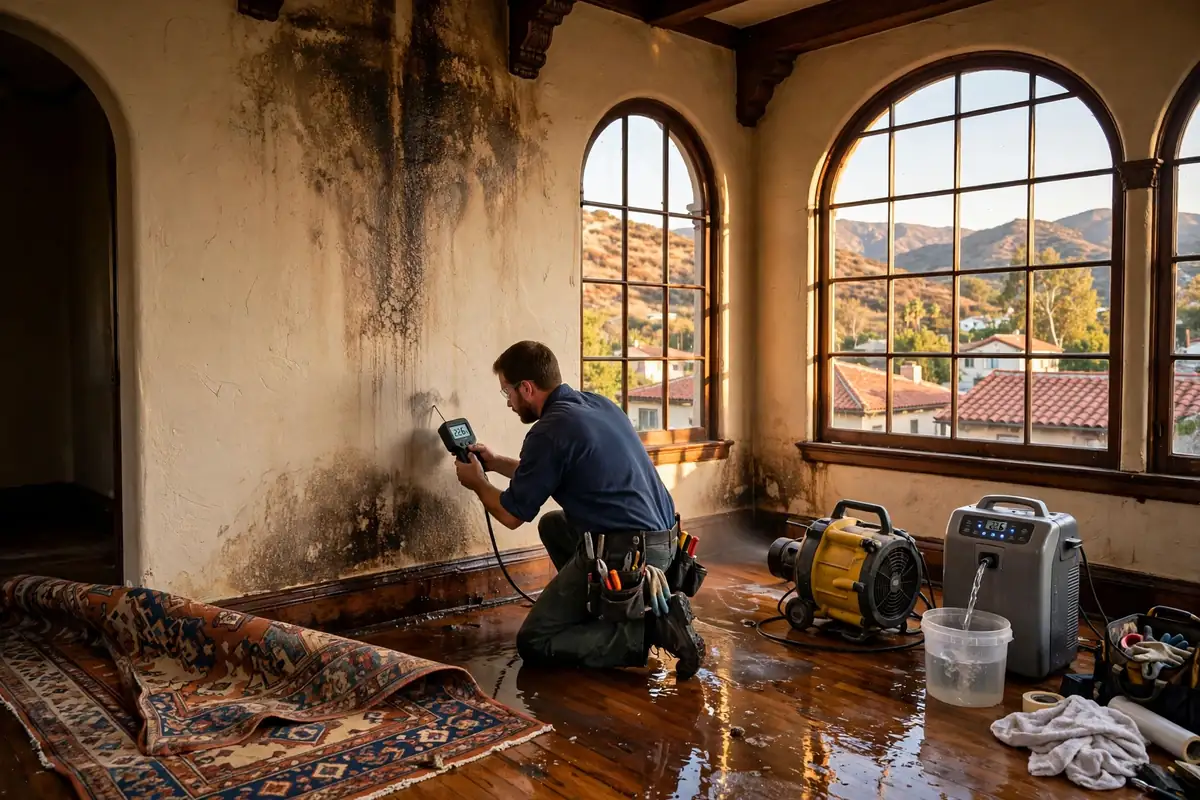
Revival and Traditional Homes
Rossmoyne, Adams Hill, El Miradero and Brockmont. Galvanized supply lines, cast iron drains and clay sewers inside plaster walls, with hardwood that cups when a slow leak runs.
Canyon and Slope Homes
Chevy Chase Canyon, Glenoaks Canyon and Verdugo Woodlands. Storm runoff, tired slope drains and retaining walls, and lower rooms that take water first.
Postwar and Slab Homes
Tropico, Citrus Grove, Grandview and the downtown edge. Slab lines under postwar floors, garage water heaters, condos and shared sewer laterals.
One thing, stated plainly: Water Damage Pros is a California company, not the service provider that dries your home. The company takes your call and matches it by ZIP code; the independent local contractor who arrives does the work. The company address, phone and email are in the footer of every page.
What Should You Do in the First Hour After Water Gets In?
Glendale's older homes and hillside streets change what the first hour looks like. Work this list in order, and only where it is safe.
Stop the source
When a pipe or appliance is the cause, turn the water off at the main shutoff, usually beside the garage or at the front of the property. In the 1920s and 1930s neighborhoods, a sudden backup can mean a clay sewer lateral has failed, so stop using water in the house until the source is found. For canyon runoff, wait for the rain to ease before working near the entry point.
Kill power to wet rooms
Where water is close to outlets, appliances or the panel, switch the breaker off for those rooms. Never step into standing water that may be electrified. Hillside water often enters at the lowest wall first, so check the downhill rooms before you decide which breakers to switch.
Photograph everything
Photograph the rooms, walls, floors, belongings, and the water line on the wall. Your insurer pays on records, not memories, so photos taken before cleanup are the strongest record you have. In historic homes, photograph original woodwork and plaster details closely, since replacements are hard to match.
Move what you safely can
Documents, electronics and furniture legs come out of the water first. Move items against downhill walls first, since that is where hillside water pools. Do not throw damaged items away until your insurer has inspected them.
Start extraction fast
Every hour of standing water is more plaster, flooring and framing lost for good. Call (833) 555-0100: an early call gets a local crew moving while damage is still small, and old-growth framing dried early usually survives.
Why Do Glendale's Older Homes and Hillsides Keep Taking Water?
Two systems age out in Glendale homes at the same time: the cast iron and clay lines under and inside the pre-war walls, and the drains meant to move storm water off steep lots. When either one fails, the water ends up indoors.
Crews read the same pattern of clues:
- Drains that slow in more than one room at once
- A sewer smell indoors after heavy rain
- Rust-tinted water at a single tap, first thing in the morning
- Bubbling paint or a stain at the base of a plaster wall
- Soil that stays damp against a retaining wall days after rain
The trades split the work the same way everywhere. A plumber tests, repairs or replaces the failed line, including shared laterals on older streets. The restoration crew handles what the water already did: extraction, drying to a verified standard, and the repairs. One call to (833) 555-0100 starts with the water and the drying, and the crew will tell you plainly where the plumbing stands. A new pipe does not dry a wall: wet plaster left to air out is how a plumbing job becomes a mold job.
Which Water Problems Can One Call Handle in Glendale?
Six kinds of water damage cover almost every Glendale water damage call. Each has its own process and risks.
Water Extraction and Standing Water Removal
Truck-mounted and portable extractors pull standing water out of floors and carpets before drying takes over. The first hours decide the size of the job.
Burst Pipe Water Damage
A supply line lets go and a room takes on water by the gallon per minute. Source stopped, water out, structure dried.
Sewage Backup Cleanup
A backup from an aging cast iron or clay line is a biohazard, not a mopping job. Contaminated materials come out, surfaces are disinfected, and the crew works protected.
Flood and Storm Water Cleanup
Canyon runoff, wash overflows and failed hillside drains bring silt and contamination with them. Pumping out, disinfecting and drying, in that order.
Structural Drying and Dehumidification
Extraction removes the water you can see. Drying removes moisture inside walls, floors and framing, verified by daily meter readings.
Mold After Water Damage
Mold can begin on wet materials within 24 to 48 hours. Fast extraction and verified drying keep a water job from becoming a mold job.
Water Damage Repair in Glendale: Putting the Rooms Back After Drying
Water damage repair in Glendale starts only when the meters say the structure is dry. Repairs put back what drying took out: plaster, hardwood, baseboards, cabinets and paint, scoped in writing before work begins.
Older Glendale homes raise the stakes on repair. Most pre-war walls here are lath and plaster, not drywall: plaster that dried in place can be skim-coated and painted, but crumbled plaster comes down to the lath and is rebuilt; matching a hand-troweled finish takes a plasterer, not a patch kit. Hardwood is the other judgment call. Solid oak in the historic neighborhoods can often be dried, sanded and refinished; boards cupped by weeks of water may not lie flat again, and the crew should say so early.
Tile, trim and thresholds
Period tile and original trim are part of what these homes are worth, so the scope should name what gets saved, not just replaced. Hillside homes add lower-level doors and thresholds, rebuilt with the drainage lesson applied, so the next storm meets a sealed edge.
The written scope
Repairs should start from a written scope: which rooms, which materials, what gets matched and what gets replaced, agreed before work begins. Kept with the drying records, it is the file your insurer reviews.
Water Damage Cleanup in Glendale Comes Before Any Repair
Nothing gets rebuilt until the rooms are clean: debris out, contaminated material removed, and hard surfaces disinfected, including the lower levels that took hillside water. Cleanup is the unglamorous middle of the job, and skipping it is how odors and mold get sealed behind fresh work.
One honest expectation: repairs run on the drying schedule. Closing a wall over a wet cavity hands you a mold problem with fresh paint on it. Dry first, verified by meter, then rebuild.
How Does the Work Run, From First Call to Fully Dry?
Four steps, in the same order on every job. A crew that skips one leaves damage behind.
Stop the water
The source is shut off or contained, power to wet rooms is made safe, and the damage is photographed before anything moves.
Extract
Standing water comes out with truck-mounted and portable extractors. Wet materials are checked one by one: what can dry in place, what has to come out.
Dry
Air movers and dehumidifiers run for days, not hours. Readings are taken daily against a dry standard; equipment comes out only when the numbers say dry.
Restore
Plaster, drywall, flooring, trim and paint go back in. The final walkthrough checks the finished work against the written scope.
Does Homeowners Insurance Cover Water Damage in Glendale?
Usually, when the water is sudden and accidental. The pattern across California policies looks like this:
Usually covered
Damage from a pipe that bursts suddenly, a failed water heater or a split supply line: extraction, structural drying, and repair of soaked plaster, floors and cabinets. The crew's moisture records and photos become part of your claim.
Usually not covered
Replacing the worn-out pipe itself, slow corrosion leaks that ran for months, maintenance failures, and rising water from outside, which needs its own flood policy. Many policies also cap mold work, so a water job left wet becomes a mold bill the policy barely touches.
Runoff is the Glendale trap: water that sheets down a canyon street and in through a garage or lower door is usually classed as surface water, which standard policies exclude. If your home sits below a slope, a separate flood policy, bought before storm season, is the real fix.
Do not wait for an adjuster before starting extraction and drying. Policies carry a duty to limit further damage, and claims are decided on the cause of the water, not on whether you protected the home quickly. Keep every record the crew gives you.
What Still Needs Attention After a Hillside Home Is Dry?
On a slope, drying the rooms is only half the job. The other half is making sure the same water does not come back with the next storm.
Lower levels dry last
Rooms cut into a hillside sit against soil that stays wet long after the rain stops, and their walls can keep drinking moisture from the ground side while the room side dries. Crews read those walls from inside and allow more time, because a lower level closed up too early is where mold shows up a month later. Dehumidification runs longer on the downhill side of the house.
Drainage gets checked, not assumed
The crew's report notes what the water did, and a good one also notes where it came from: a slope drain outlet buried in landscaping, a retaining wall with weep holes choked by soil, a driveway that pitches toward the garage. Those fixes belong to drainage and plumbing trades, separate from drying, but the documentation tells the homeowner exactly what to have corrected before storm season returns.
Thresholds and seals are part of the repair
When lower doors and garage entries are rebuilt, the repair scope includes the seals and thresholds that failed. A door that took runoff once will take it again at the same gap. Raising a threshold, renewing a seal and clearing the drain at the door are small line items next to a second flood, and they belong in the written scope from the start.
Glendale: The City Behind the Calls
Glendale is a foothill city of just under 200,000 people, tucked against the Verdugo Mountains at the eastern edge of the San Fernando Valley. It is older, wetter, and hillier than most of the basin around it, and all three of those facts shape the water damage here.
The Weather: Wetter Than the Basin Below
Glendale averages about 18 to 21 inches of rain a year, noticeably more than the basin below it, because the Verdugo Mountains squeeze moisture out of winter storms. Most of it falls between November and April, with February the wettest month, and the totals swing hard with the Pacific: El Niño winters can pass 30 inches, La Niña winters can fall under 10. Summers are hot and dry, winters mild, and the hills that give the city its views also give it runoff: a heavy storm sends water down the canyons and into the streets and lower rooms below.
When Water Damage Peaks in Glendale
Winter, December through March, is the peak season, and February is usually the busiest month. The first heavy rain finds roof weaknesses in the 1920s and 1930s homes, and the storms that follow push hillside runoff into lower rooms and garages in the canyon neighborhoods. In a wet El Niño winter, the calls keep coming into April.
Summer brings a quieter, different pattern: air conditioning condensate lines clogging in the heat, irrigation lines breaking under dry soil, and slab leaks that show up in every month, because they come from pressure and old pipes, not weather. Late spring, April and May, is usually the calmest stretch, between the last storm and the first heat wave.
The History: A Rancho Town That Grew Up Fast
The land was long home to the Tongva people. In 1798 José María Verdugo received the Rancho San Rafael land grant from the Spanish governor, and the Catalina Verdugo Adobe, the city's oldest building, still stands from that era. Residents formed a townsite and chose the name Glendale in 1884, the city incorporated on February 15, 1906, and annexed the neighboring town of Tropico in 1918. The 1920s were the great building decade: the population jumped from about 14,000 in 1920 to more than 62,000 in 1930, filling the hills with the Craftsman and Spanish Revival homes that still define the older neighborhoods. That is why so much of the city's plumbing is a century old: cast iron and clay lines laid when the streets were new.
The City at a Glance
Glendale covers about 30.6 square miles and is home to just under 200,000 people, the fourth largest city in the county. It is divided into 34 neighborhoods, from the flat streets near the river to the hillside homes under the Verdugo Mountains, and its downtown holds offices, hospitals, and shops at the foot of the mountains. Forest Lawn opened in 1906, the same year the city incorporated. For a homeowner, the practical fact is the slope: a house at the top of a canyon street and a house at the bottom face different water risks, which is why matching runs by ZIP code and street, not by city name.
Questions Glendale Homeowners Ask After Water Damage
How fast can a crew get to my Glendale home?
Crews are matched by ZIP code inside the city, so the crew heading to you is already working the foothill neighborhoods, not crossing the valley in traffic. Most calls get a crew the same day, often within hours, and timing for your ZIP code is stated honestly on the call. For hillside addresses, mention gate codes and steep driveways, so the crew brings the right equipment.
What are the signs my cast iron or clay pipes are failing?
Slow drains in more than one room, gurgling after a flush, a sewer smell that shows up after rain, rust-tinted water at one tap, and backups that keep returning to the lowest fixture. None of these is proof on its own; a camera inspection of the line is what settles it, and the crew's footage tells you whether you are looking at a blockage, a cracked run or a collapsed section.
Can water-damaged plaster be dried in place, or does it have to come out?
Often it can. Plaster wet by clean water and reached within a day or two frequently dries in place with meter-led drying, though it dries slower than drywall. It has to come out when the water was contaminated, when the plaster has crumbled or separated from the lath, or when readings show the cavity behind it staying wet.
Does homeowners insurance cover hillside runoff into my lower level?
Usually not under a standard policy. Water that flows over the ground and enters through a door or garage is classed as surface water or flood, which standard policies exclude; a separate flood policy covers it. Damage from a pipe that fails inside the home is a different story and is usually covered. Either way, photograph everything before cleanup starts.
Who pays when a shared sewer lateral fails?
It depends on where the break sits. Laterals are commonly the owner's responsibility up to the city connection, and shared lines serving two homes split by agreement or by where the failure is found. The camera footage from the crew locates the break, and that evidence is what insurers and neighbors argue from, so keep it.
How long does drying take in a Glendale home?
Most homes run 3 to 5 days of structural drying. Plaster walls, lower levels cut into a hillside and rooms over a slab tend toward the longer end, because those assemblies hold moisture deeper. The crew takes meter readings daily, and equipment leaves when the numbers match a dry standard, not when a set number of days has passed.
Which Glendale Neighborhoods and ZIP Codes Are Covered?
Matching is done by ZIP code. This guide covers the city of Glendale: 14 ZIP codes, from the canyon streets under the Verdugos to the southern flats:
All 14 covered city ZIP codes:
Just outside the list but still in Glendale? Call anyway. Matching runs on the ZIP code of the home, and the closest crew takes the job.
Water in the House Right Now?
Shut the water off at the main, keep clear of electrical hazards, and take photos before anything moves. Then make the one call that starts your Glendale water damage restoration job with a local crew: extraction first, meter-checked drying behind it, and a written scope first.