Water Damage Restoration San Diego, CA: Slab Leaks, Burst Pipes and Flooded Rooms, Dried Right
In San Diego, water trouble rarely announces itself. It starts as a warm spot on a Clairemont kitchen floor, a water bill that jumps for no reason, or a Mission Valley garage taking on river water after a winter storm. Homeowners looking for water damage restoration in San Diego call one number here and get matched with an independent local crew that knows these streets, these slab homes and this soil: extraction first, meter-checked drying behind it, and repairs scoped in writing before work begins.
What To Tell Us When You Call
Four details that help the crew matched to your call bring the right equipment and start drying sooner.
📞 (833) 555-0100Street address and ZIP code, so the crew closest to your neighborhood heads out to you.
A slab leak, a burst pipe, a water heater, an appliance, the roof, a sewer line, or storm water through a door.
If water is still flowing, stay on the line: we will talk you through shutting it off.
The rooms affected, whether floors, walls or ceilings are wet, and roughly how long it has been.
If you have standing water in a San Diego home right now: shut off the water at the main if it is safe, keep clear of wet electrical outlets, take photos and video for your insurer, and call (833) 555-0100 to be matched with a local crew. Most San Diego water damage calls start exactly this way. For cleanup jobs like these, the first day matters most: extraction and drying started within 24 hours can save drywall, flooring and cabinets that a weekend of waiting will lose to swelling and mold.
Water Damage Restoration San Diego Crews Read Like Locals, Because They Are
San Diego water damage follows the age of the neighborhood. Postwar slab suburbs hide leaking copper lines under their floors, the valley floor floods along the river, and coastal stucco homes take wind-driven rain. A local crew reads all three patterns on sight.
Start with the slab suburbs. Clairemont, Bay Park, Serra Mesa, Mira Mesa, Tierrasanta, University City and Rancho Bernardo were built mostly between the 1950s and the 1980s on concrete slabs, with soft copper lines underneath. That copper corrodes in San Diego soil over 50 to 70 years, so whole streets are now in the failure window, one pinhole at a time. The water rarely shows where the pipe broke: it travels along the slab top and wicks up at a wall base 15 to 20 feet away.
Then there is the water that arrives from outside. Mission Valley sits on the San Diego River floodplain, and hard winter rain still pushes river water into ground-floor garages and condos there. Point Loma and Pacific Beach take wind-driven rain that finds a cracked tile or tired roof edge. Inland, the everyday calls are quieter: water heaters failing in garages and supply lines letting go under sinks.
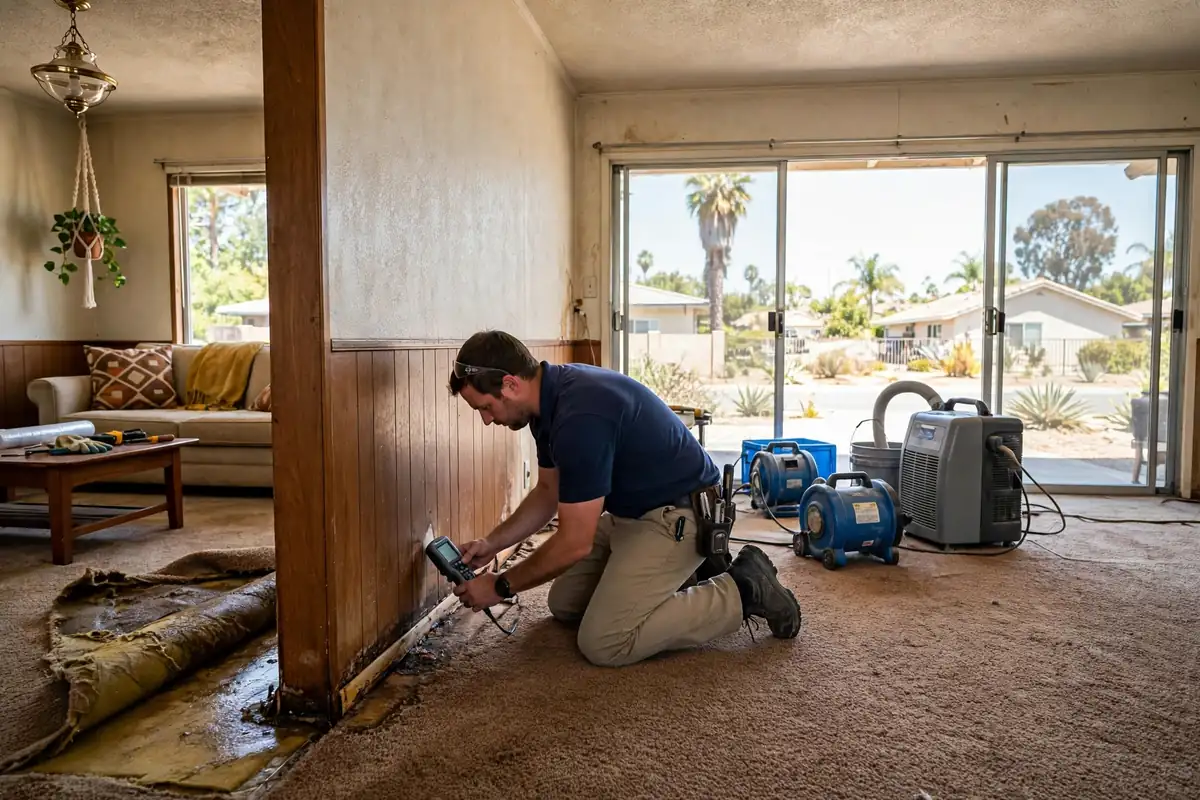
Ranch Homes, 1950s to 1980s
Slab homes in Clairemont, Serra Mesa and Mira Mesa. The signature job is the slab leak: copper under the floor, warm spots, water surfacing rooms away from the break.
Stucco Homes and Condos
Point Loma, Pacific Beach, La Jolla and Mission Valley. Wind-driven rain, river flooding, and low-slope roofs that pond water until it finds a seam.
Newer Tract Homes
Rancho Bernardo, Scripps Ranch, Tierrasanta and Carmel Valley. Garage water heaters and second-floor laundry rooms: smaller leaks, found later, dried carefully.
What Should You Do in the First Hour After Water Gets In?
In San Diego, the first hour matters most when a slab leak is quietly filling the rooms above it. Work this list in order, and only where it is safe.
Stop the source
If a pipe or appliance is the cause, turn the water off at the main shutoff, which on most San Diego homes sits at the front of the property or in the garage. A warm patch on a tile floor or the sound of running water when every tap is off usually means a slab leak, so shut the water off and leave the floor alone. For Mission Valley storm water, wait until the rain eases before working near the entry point.
Kill power to wet rooms
If water is near outlets, appliances or the panel, switch the breaker off for those rooms. Never step into standing water that may be electrified. In slab homes the water often spreads under flooring first, so check the rooms beside the wet one before you decide which breakers to switch.
Photograph everything
Rooms, walls, floors, belongings, the source itself, and the water line on the wall. Insurers pay on records, not memories, and photos taken before cleanup are the strongest record. Photograph the warm floor patch or the wet baseboard too, since a slab leak leaves little visible damage at first.
Move what you safely can
Documents, electronics and furniture legs out of the water. In coastal homes, move rugs and low bookcases first, since salt air slows drying and mildew starts fast on wet fabric. Do not throw damaged items away until your insurer has seen or released them.
Start extraction fast
Every hour of standing water is more drywall and flooring that cannot be saved. Call (833) 555-0100: an early call gets a local crew moving while damage is still small, and a meter reading in that first hour shows whether the slab underneath is wet.
How Do You Know If You Have a Slab Leak?
The fastest home test needs no tools: turn off every tap, appliance and irrigation line, then look at your water meter. If the dial or leak indicator still moves, water is escaping somewhere, and under a slab home the line below the floor is the first suspect.
The break is sealed under concrete, so crews look for a pattern of small clues, not one dramatic sign:
- A warm spot on tile, vinyl or wood flooring, from a hot-water line leaking below
- A water bill that steps up month over month with no change in usage
- The sound of water running when the house is quiet and every tap is off
- Mold, bubbling paint or a soft wall base with no fixture anywhere above it
- Flooring that lifts, darkens or feels damp, often far from any plumbing
- New hairline cracks in tile, where moving water has washed soil out from under the slab
Finding and fixing a slab leak are three different jobs done by three different trades. A leak detection specialist pinpoints the break by sound and pressure. A plumber repairs the line or, on copper that keeps failing, reroutes a new line through the walls so the slab is left alone. The restoration crew handles what the water already did: extraction, drying to a verified standard, and the repairs. One call to (833) 555-0100 starts with the water and the drying, and the crew will tell you plainly where the detection and plumbing steps stand.
Which Water Problems Can One Call Handle in San Diego?
Six kinds of water damage cover almost every San Diego water damage call. Each has its own process and its own risks.
Water Extraction and Standing Water Removal
Truck-mounted and portable extractors pull standing water out of floors, carpets and padding before drying takes over. The first hours decide the size of the job.
Burst Pipe Water Damage
A supply line lets go and a room takes on water by the gallon per minute. Source stopped, water out, structure dried.
Sewage Backup Cleanup
A sewage backup is a biohazard, not a mopping job. Contaminated materials come out, hard surfaces are disinfected, and the crew works protected.
Flood and Storm Water Cleanup
San Diego River flooding in Mission Valley and wind-driven coastal rain bring silt and contamination with them. Pumping out, mucking out, disinfecting and drying, in that order.
Structural Drying and Dehumidification
Extraction removes the water you can see. Drying removes the moisture inside walls, floors and framing, verified by daily meter readings.
Mold After Water Damage
Mold can begin on wet materials within 24 to 48 hours. Fast extraction and verified drying keep a water job from becoming a mold job.
Water Damage Repair in San Diego: Putting the Rooms Back After Drying
Water damage repair in San Diego starts only when the meters say the structure is dry. Repairs put back what drying took out: drywall, flooring, baseboards, cabinets and paint, scoped in writing before work begins.
Drywall is where the repair decisions get made. Walls that dried in place need little more than primer and paint. Walls that were flood cut, opened in a clean horizontal line so the cavity could dry, need new board, texture matched to the existing finish, and paint blended across the whole wall. Baseboards come off during drying on most slab jobs, because the wall base is where slab water wicks up.
Floors and cabinets
Luxury vinyl and tile often survive when drying starts fast. Laminate and engineered wood swell at the seams and usually come out; solid hardwood can sometimes be dried and refinished. Cabinet bases soak up water early, so the crew documents which boxes can be saved: that record shapes the claim.
The written scope
Repairs should start from a written scope: which rooms, which materials, what gets matched and what gets replaced, agreed before the first board is cut. Kept with the drying records, it is the file your insurer reviews.
Water Damage Cleanup in San Diego Comes Before Any Repair
Nothing gets rebuilt until the rooms are clean: debris out, contaminated material removed, and hard surfaces washed and disinfected. Cleanup is the unglamorous middle of the job, and skipping it is how odors and mold get sealed behind fresh work.
One honest expectation: repairs run on the drying schedule. A crew that patches walls over a wet cavity is handing you a mold problem with fresh paint on it. Dry first, verified by meter, then rebuild.
How Does the Work Run, From First Call to Fully Dry?
Four steps, in the same order on every job. A crew that skips one is leaving damage behind.
Stop the water
The source is shut off or contained, power to wet rooms is made safe, and the damage is photographed before anything moves.
Extract
Standing water comes out with truck-mounted and portable extractors. Wet materials are checked one by one: what can dry in place, and what has to come out.
Dry
Air movers and dehumidifiers run for days, not hours. Readings are taken daily against a dry standard, and equipment comes out only when the numbers say dry.
Restore
Drywall, flooring, trim and paint go back in. The final walkthrough checks the finished work against the written scope.
Does Homeowners Insurance Cover Water Damage in San Diego?
Usually, when the water is sudden and accidental. The pattern across California policies looks like this:
Usually covered
The damage caused by a burst pipe, a failed water heater or a sudden slab leak: extraction, structural drying, and repair of soaked flooring, drywall and cabinets. The crew's moisture records and photos become part of your claim documentation.
Usually not covered
The plumbing repair itself, slow leaks that ran for months, maintenance failures, and rising water from outside the home. River flooding in Mission Valley needs its own flood policy. Many policies also cap mold work, so a water job left wet becomes a mold bill the policy barely touches.
Do not wait for an adjuster before starting extraction and drying. Policies carry a duty to limit further damage, and claims are decided on the cause of the water, not on whether you protected the home quickly. Keep every record the crew gives you, and read your declarations page: this is the general pattern, not advice about your policy.
What Does Professional Drying Actually Involve in a San Diego Home?
Extraction is the loud part. The days after it are a measured process with its own equipment, readings and decisions, and that process is where most of the saving happens.
Moisture mapping comes first
Before equipment is placed, the crew maps the water: a moisture meter and a thermal camera trace how far it travelled through walls, floors and cabinets, including rooms that look dry. In slab neighborhoods that map regularly shows water 15 to 20 feet from the source, wicked along the slab and up the wall bases. The map becomes the drying plan and the first page of the insurance file, because it proves where the water went instead of where it was seen.
Drying is a system, not a fan in the corner
Air movers, dehumidifiers and, where walls are closed, cavity drying work as one system sized to the wet volume. Placement follows the map, and the crew returns daily to take readings against a dry standard taken from an unaffected part of the same house. Equipment moves or comes out based on those numbers. A room that feels dry to the touch can still hold moisture deep in the framing, which is why the readings, not the calendar, end the job.
Some materials come out on purpose
Baseboards are pulled so wall bases can dry. Wet insulation, swollen particle-board cabinets and flooring that has peaked are removed because they cannot be dried to standard in place. A flood cut, one straight cut above the water line, opens a wall so the cavity can dry and be disinfected. Each removal is photographed and listed in the scope, because what comes out is what the repair phase and the claim have to account for.
San Diego: The City Behind the Calls
San Diego is California's oldest city and its second largest, a coastal city of about 1.4 million people on San Diego Bay, where the weather is famously mild and the rain, when it comes, arrives almost entirely in winter. That combination shapes the water damage here more than most homeowners expect.
The Weather: Mild, Dry, and Deceptive
San Diego averages roughly 9 to 13 inches of rain a year, about 10.65 inches along the coast, most of it between December and March. August is the warmest month, with highs around 77 to 80 degrees, while December and January nights drop to about 50. Snowfall in the city is virtually non-existent, which is why burst pipes from freezing, a real risk in the high desert, are almost unheard of here; San Diego's pipes fail from corrosion and pressure, not cold. The catch is the marine layer, the low coastal cloud that rolls in overnight and burns off late in the morning, especially in May and June. It keeps homes damp for hours after sunrise, and it is why a wet wall in a coastal San Diego home can take longer to dry than the same wall ten miles inland. Inland valleys run hotter still, especially when dry Santa Ana winds blow in from the desert, and the winter storms that do arrive often come as back to back atmospheric river events that flood low lying streets in Mission Valley and along the San Diego River.
When Water Damage Peaks in San Diego
Winter, December to March, is the busy season. Most of San Diego's rain falls in those four months, and February is the only month that averages 2 inches or more. The calls in winter are storm calls: roof leaks found during the first heavy rain, hillside runoff reaching lower rooms, and street flooding in Mission Valley and along the San Diego River when atmospheric river storms arrive back to back.
The rest of the year does not go quiet. Slab leaks and pinhole copper failures happen in every month, because they come from pressure and corrosion, not weather, and summer brings its own pattern: air conditioning condensate lines clogging in August heat and irrigation lines breaking under dry, shifting soil. The quietest stretch is usually late spring, April and May, after the rains have ended and before the summer heat loads the cooling systems.
The History: California's First City
San Diego is the birthplace of California. The Kumeyaay people lived here long before Europeans arrived; in 1769 Gaspar de Portolá established the Presidio and Saint Junípero Serra founded Mission San Diego de Alcalá, the first European settlement in Alta California. The city passed to Mexican rule after Mexico's independence, then to the United States in 1848 after the Mexican-American War, becoming a county seat when California gained statehood in 1850. Growth came in waves: the Santa Fe Railway arrived in 1885, the 1915-16 Panama-California Exposition put Balboa Park on the map, and the Navy's expansion through World War II turned the city into a major military port. That history matters for water damage in a concrete way: the oldest homes, in neighborhoods like Old Town and parts of North Park, still carry galvanized and cast iron lines from the early 1900s, while the 1950s to 1980s tracts carry the soft copper slab lines that fail most often now. Two eras of plumbing, two different failure patterns, one city.
The City at a Glance
San Diego covers about 372 square miles, from the beaches of La Jolla and Pacific Beach to the inland mesas and peaks like Cowles Mountain, 1,591 feet above the bay. About 1.4 million people live here, the second largest city in California and the eighth largest in the United States. The economy runs on defense and the Navy, biotechnology, tourism, and international shipping through its deepwater harbor. Landmarks like Balboa Park, Cabrillo National Monument, and Old Town draw millions of visitors a year. For a homeowner, the practical fact is distance: a home in Rancho Bernardo or Otay Mesa can sit 25 miles from the crews nearest the center, which is why matching by ZIP code, not by city name, decides how fast help arrives.
Questions San Diego Homeowners Ask After Water Damage
How fast can a crew get to my San Diego home?
Crews are local to the city, so most San Diego calls are answered with a crew the same day, often within hours. City-edge addresses can take longer, and you will be told honestly on the call what the timing looks like for your ZIP code.
What are the signs of a slab leak under my floor?
Look for a warm or damp floor spot with no spill to explain it, a water bill that steps up for no reason, the sound of water running when every tap is off, and mold at a wall base with no fixture above it. The test: shut off all water, then watch the meter. If the dial still moves, water is escaping under the home.
Can water-damaged drywall be dried in place, or does it have to be cut out?
Both outcomes are normal. Drywall wet by clean water and reached within a day or two can often be dried in place, verified by meter readings. Drywall that is sagging, soft, or soaked by sewage or flood water must be cut out, usually in a clean horizontal flood cut, so the wall cavity behind it can dry.
Can we stay in the home while the drying equipment runs?
Usually, yes. Most families stay while air movers and dehumidifiers run for three to five days. The trade-offs are noise, warm dry air, and a room or two partly out of use. Leaving is worth considering when sewage is involved, or when someone at home has breathing difficulties.
Does homeowners insurance cover slab leak damage?
The pattern is split in two. Damage the leaking water caused, soaked flooring, drywall, cabinets and the drying itself, is usually covered when the leak was sudden and accidental. The plumbing repair itself is usually treated as maintenance and is not covered. Photograph everything, and start drying without waiting for an adjuster: policies expect you to limit further damage.
How long does structural drying take?
Most San Diego homes reach a verified dry standard in three to five days. A single-room leak can finish sooner; a slab leak that ran for weeks can run longer. Drying ends on numbers, not a schedule: daily meter readings are compared against a dry standard, and equipment comes out only when they match.
Which San Diego Neighborhoods and ZIP Codes Are Covered?
Matching is done by ZIP code. This guide covers the city of San Diego proper: 79 ZIP codes, from the coast to the inland mesas, including:
All 79 covered city ZIP codes:
Just outside the city line, in La Mesa, Santee, El Cajon or Chula Vista? Call anyway: the company matches by ZIP code across California, and the call routes to the crew covering your address.
Water in the House Right Now?
Shut the water off at the main, keep clear of electrical hazards, and take photos before anything moves. Then make the one call that starts your San Diego water damage restoration job with a local crew: extraction first, meter-checked drying behind it, and a written scope before repairs begin.