Home / Locations / Los Angeles
Los Angeles • 137 Los Angeles ZIP Codes CoveredWater Damage Restoration Los Angeles, CA: Old Pipes, Hillside Runoff and Flooded Floors, Dried Right
In Los Angeles, water trouble often starts inside the walls. A galvanized line in a 1920s Spanish Revival gives out behind the plaster, a hillside home takes storm runoff through a lower-level door, a Valley floor goes soft over a slab line nobody has seen in sixty years. Homeowners looking for water damage restoration in Los Angeles call one number here and get matched with an independent local crew that knows these streets and this housing stock: extraction first, meter-checked drying behind it, and repairs scoped in writing. One call, one local crew, one job done in the right order.
What To Tell Us When You Call
Four details that help the crew matched to your call bring the right equipment sooner.
📞 (833) 555-0100Street address and ZIP code, so the crew closest to your neighborhood heads out to you.
A failed pipe, a water heater, an appliance, the roof, a sewer line, or storm water through a door.
If water is still flowing, stay on the line: we will talk you through shutting it off.
The rooms affected, whether floors, walls or ceilings are wet, and how long it has been.
If you have standing water in a Los Angeles home: shut off the water at the main if it is safe, keep clear of wet outlets, take photos and video for your insurer, and call (833) 555-0100 to be matched with a local crew. Most Los Angeles water damage calls start exactly this way. For cleanup jobs like these, the first day matters most: extraction and drying started within 24 hours can save plaster, hardwood and cabinets that a weekend of waiting loses to swelling and mold.
Water Damage Restoration Los Angeles Crews Read Like Locals, Because They Are
Los Angeles water damage follows the age and the slope of the neighborhood. Pre-war homes hide corroding pipes inside plaster walls, hillside streets shed storm water into lower rooms, and postwar Valley tracts sit on slabs with aging lines underneath. A local crew reads all three patterns on sight.
Start with the old housing stock. Much of central Los Angeles was built before 1960: Spanish Revival and Craftsman homes in Los Feliz, Silver Lake, Highland Park and West Adams, plumbed with galvanized steel that corrodes from the inside. Those pipes were given 40 to 50 years; most are well past it. The failures are rarely dramatic: pressure fades, a pinhole opens inside a wall, and by the time a stain blooms on a ceiling, the framing has been wet for weeks.
Then there is the slope. Hillside neighborhoods, from Echo Park and Mount Washington to the Hollywood Hills, drain toward their lowest doors, and a hard atmospheric river storm pushes runoff and silt into ground-level rooms. Down on the flats, river and creek corridors take standing street water finding every low threshold. In the San Fernando Valley, postwar slab tracts add the third pattern: supply lines under concrete that fail quietly and surface rooms away from the break.
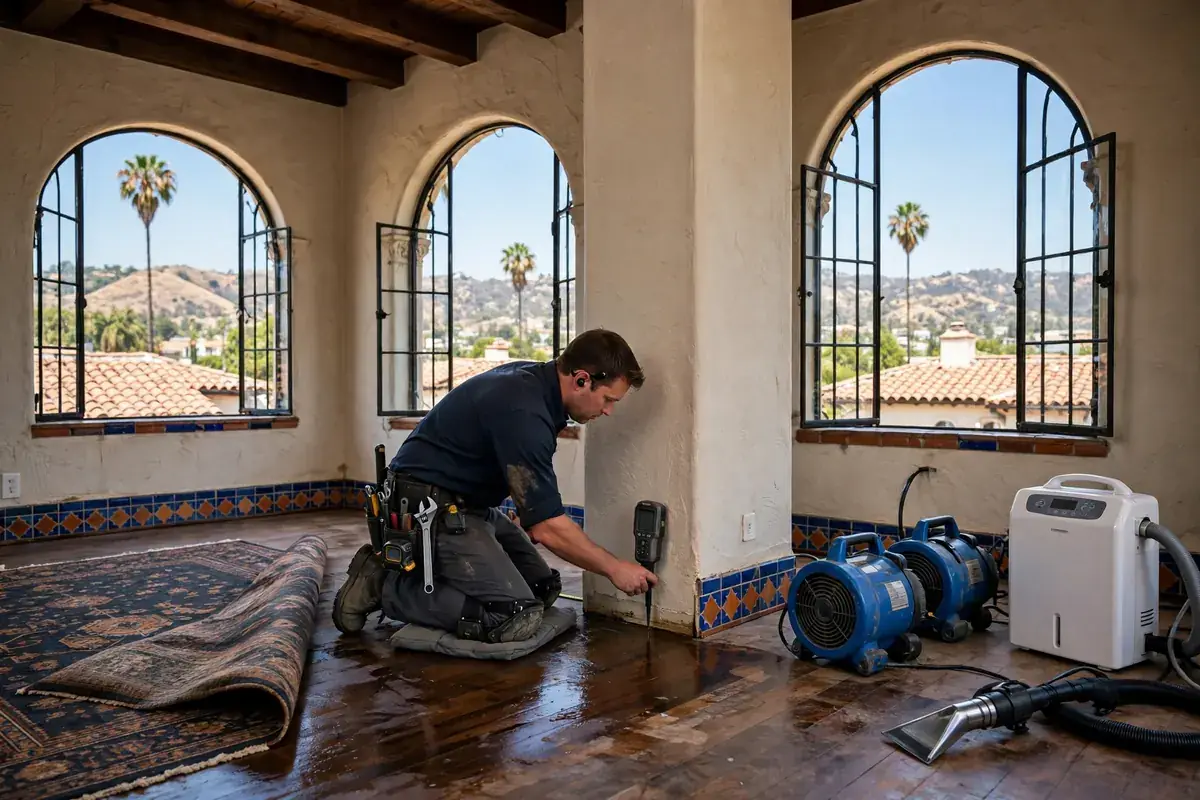
Revival and Craftsman Homes
Los Feliz, Silver Lake, Highland Park and West Adams. Galvanized pipes inside plaster walls, cast iron drains, and hardwood that cups when a slow leak runs.
Homes on the Slope
Echo Park, Mount Washington and the Hollywood Hills. Storm runoff, tired retaining drains, and lower rooms that take water first.
Postwar Slab Tracts
Van Nuys, Reseda, Woodland Hills and Chatsworth. Slab lines under 1950s floors, garage water heaters, and second-floor laundry leaks.
One thing, stated plainly: Water Damage Pros is a California company, not the service provider that dries your home. The company takes your call and matches it by ZIP code; the independent local contractor who arrives does the work. The company address, phone and email are in the footer of every page.
What Should You Do in the First Hour After Water Gets In?
Los Angeles homes fail in different ways by neighborhood, so the first hour is about finding your home's weak point fast. Work this list in order, and only where it is safe.
Stop the source
If a pipe or appliance is the cause, turn the water off at the main shutoff, usually at the front of the property or by the garage. In pre-war homes with galvanized pipe, a burst often follows a pressure spike, so shut the water off even if the flow looks small. For hillside runoff, stay out of the flow path and wait for the rain to ease.
Kill power to wet rooms
If water has reached outlets, appliances or the panel, switch those rooms off at the breaker. Never step into standing water that may be electrified. In older homes the panel may sit in a garage that floods first, so do not wade to it; call for help instead.
Photograph everything
Rooms, walls, floors, belongings, and the water line on the wall. Insurers pay on records, not memories; photos taken before cleanup are the strongest record. Photograph cracked or bubbling plaster closely, since plaster hides how far water has traveled.
Move what you safely can
Get documents, electronics and furniture legs out of the water. In Valley slab tracts, water runs under doors into the next room fast, so move items from the rooms beside the wet one too. Do not throw damaged items away until your insurer has seen them.
Start extraction fast
Every hour of standing water is more plaster, flooring and framing that cannot be saved. Call (833) 555-0100: an early call gets a local crew moving while damage is still small, and plaster dried in the first day usually survives.
Why Do So Many Older Los Angeles Homes Spring Leaks?
Galvanized steel pipe corrodes from the inside out. In a home built before 1960, the supply lines have been narrowing and rusting for decades, and the first visible leak is rarely the first leak: it is the first one that reached a surface.
Crews read the same pattern of clues:
- Water pressure that has faded slowly over the years
- Water that runs rust-tinted for a few seconds on the first draw of the morning
- Small leaks that keep returning at joints and valve stems
- A ceiling stain or bubbling plaster with no roof problem above it
- Hardwood that cups or darkens along one wall, far from any fixture
The trades split the same way everywhere. A plumber tests, repairs or, when a galvanized run is finished, repipes the line in copper or PEX. The restoration crew handles what the water already did: extraction, drying to a verified standard, and the repairs. One call to (833) 555-0100 starts with the water and the drying, and the crew will tell you plainly where the plumbing stands. Repiping fixes the source, but it does not dry a wall: wet plaster left to air out is how a pipe job becomes a mold job.
Which Water Problems Can One Call Handle in Los Angeles?
Six kinds of water damage cover almost every Los Angeles water damage call. Each has its own process and risks.
Water Extraction and Standing Water Removal
Truck-mounted and portable extractors pull standing water out of floors and carpets before drying takes over. The first hours decide the size of the job.
Burst Pipe Water Damage
A supply line lets go and a room takes on water by the gallon per minute. Source stopped, water out, structure dried.
Sewage Backup Cleanup
A sewage backup is a biohazard, not a mopping job. Contaminated materials come out, surfaces are disinfected, and the crew works protected.
Flood and Storm Water Cleanup
Hillside runoff, river and creek flooding, and wind-driven rain bring silt and contamination with them. Pumping out, disinfecting and drying, in that order.
Structural Drying and Dehumidification
Extraction removes the water you can see. Drying removes moisture inside walls, floors and framing, verified by daily meter readings.
Mold After Water Damage
Mold can begin on wet materials within 24 to 48 hours. Fast extraction and verified drying keep a water job from becoming a mold job.
Water Damage Repair in Los Angeles: Putting the Rooms Back After Drying
Water damage repair in Los Angeles starts only when the meters say the structure is dry. Repairs put back what drying took out: plaster, hardwood, baseboards, cabinets and paint, scoped in writing before work begins.
Older Los Angeles homes raise the stakes on repair. Many pre-war walls are lath and plaster, not drywall: plaster that dried in place can be skim-coated and painted, but crumbled plaster has to come down to the lath and be rebuilt; matching a hand-troweled finish takes a plasterer, not a patch kit. Hardwood is the other judgment call. Solid oak can often be dried, sanded and refinished; boards cupped by weeks of water may not lie flat again, and the crew should say so early.
Tile, trim and cabinets
Spanish tile and original trim are part of what these homes are worth, so the scope should name what gets saved, not just replaced. Cabinet bases soak up water early; the crew documents which can be saved, because that record shapes the claim.
The written scope
Repairs should start from a written scope: which rooms, which materials, what gets matched and what gets replaced, agreed before work begins. Kept with the drying records, it is the file your insurer reviews.
Water Damage Cleanup in Los Angeles Comes Before Any Repair
Nothing gets rebuilt until the rooms are clean: debris out, contaminated material removed, and hard surfaces washed and disinfected where they can be. Cleanup is the unglamorous middle of the job, and skipping it is how odors and mold get sealed behind fresh work.
One honest expectation: repairs run on the drying schedule. Closing a wall over a wet cavity hands you a mold problem with fresh paint on it. Dry first, verified by meter, then rebuild.
How Does the Work Run, From First Call to Fully Dry?
Four steps, in the same order on every job. A crew that skips one leaves damage behind.
Stop the water
The source is shut off or contained, power to wet rooms is made safe, and the damage is photographed before anything moves.
Extract
Standing water comes out with truck-mounted and portable extractors. Wet materials are checked one by one: what can dry in place, what has to come out.
Dry
Air movers and dehumidifiers run for days, not hours. Readings are taken daily against a dry standard; equipment comes out only when the numbers say dry.
Restore
Plaster, drywall, flooring, trim and paint go back in. The final walkthrough checks the finished work against the written scope.
Does Homeowners Insurance Cover Water Damage in Los Angeles?
Usually, when the water is sudden and accidental. The pattern across California policies looks like this:
Usually covered
Damage from a pipe that bursts suddenly, a failed water heater or a split supply line: extraction, structural drying, and repair of soaked plaster, floors and cabinets. The crew's moisture records and photos become part of your claim.
Usually not covered
Replacing the worn-out pipe itself, slow corrosion leaks that ran for months, maintenance failures, and rising water from outside, which needs its own flood policy. Many policies also cap mold work, so a water job left wet becomes a mold bill the policy barely touches.
Do not wait for an adjuster before starting extraction and drying. Policies carry a duty to limit further damage, and claims are decided on the cause of the water, not on whether you protected the home quickly. Keep every record the crew gives you.
How Do Crews Dry Plaster Walls Without Gutting the Whole Room?
In a pre-war Los Angeles home, the walls are part of the house's value. Drying them in place is slower than demolition, and it is usually the right first attempt.
Plaster dries from both faces
Lath and plaster hold water differently from drywall: the plaster layer is dense, the wood lath behind it drinks, and the cavity can stay wet after the surface reads dry. Crews dry from the room side with air movement and dehumidification, and from inside the cavity with directed air through small holes drilled at the baseboard line, later hidden behind the replaced baseboard. Readings are taken through the plaster, not just on it.
Containment keeps the rest of the house clean
Where plaster does have to come down, or contaminated water was involved, the work area is sealed with plastic containment and run under negative air, so dust is pulled out through filtration instead of drifting into clean rooms. Furniture and belongings in the work zone are packed out or covered, and the crew documents what was moved, which the insurer expects to see.
When plaster still has to come out
Drying in place has limits. Plaster that has crumbled, separated from its lath, or soaked in contaminated water is removed to the lath and rebuilt. The decision is made from readings and condition, room by room, not from a blanket rule. Homeowners hear the answer early, with the moisture numbers behind it, so the repair scope that follows holds no surprises.
Los Angeles: The City Behind the Calls
Los Angeles is the largest city in California and the second largest in the United States, a coastal basin city of about 3.9 million people spread across 469 square miles. It is a city of many climates and many eras of housing at once, and that variety is exactly what makes its water damage so varied.
The Weather: One City, Many Climates
Downtown Los Angeles averages about 15 inches of rain a year, almost all of it between November and March, with February the wettest month. But averages hide the spread: the San Fernando Valley can take 16 to 20 inches, the foothills more, and the coast less, and the pattern swings year to year, with dry years of 5 to 10 inches followed by wet years over 20. Summers are warm and dry, winters mild, and the marine layer that cools the coast each morning rarely reaches the Valley, where summer heat runs 10 to 15 degrees hotter. That spread is the point for a homeowner: a house in the hills deals with runoff and saturated slopes, a house on the flat deals with a high water table after a wet winter, and both can sit in the same ZIP code.
When Water Damage Peaks in Los Angeles
Winter, December through March, is the peak season. The first heavy rain of the season finds every roof weakness at once, and the storms that follow bring hillside runoff, saturated yards, and street flooding where the drainage was built for a drier era. February, the wettest month downtown, is usually the busiest month of the year for storm calls.
Summer has its own pattern. Air conditioning condensate lines clog in the Valley heat, irrigation lines break under dry soil, and slab leaks show up in every month, because they come from pressure and old copper, not weather. The quietest stretch is usually late spring, April and May, between the last winter storm and the first heat wave.
The History: From Pueblo to Metropolis
Los Angeles began on September 4, 1781, when 44 settlers founded El Pueblo de Los Ángeles on the site of the Tongva village of Yaanga, under Spanish governor Felipe de Neve. It passed from Spain to Mexico, then to the United States in 1848, and incorporated as a city in 1850. Growth came in surges: the railroads in the 1880s, the film industry in the 1910s, the aerospace boom of the Second World War, and the postwar decades that filled the Valley with tract homes. Each surge left its own plumbing behind: galvanized lines in the pre-war homes near the center, cast iron in the 1920s and 1930s neighborhoods, copper in the postwar tracts. A plumber in this city reads the decade of a house before touching a pipe.
The City at a Glance
Los Angeles covers about 469 square miles, from the beaches of Venice and Pacific Palisades to the San Fernando Valley and the harbor at San Pedro, and is home to about 3.9 million people, the largest city in California and the second largest in the United States. It is the center of the film and television industry, a major port city, and the seat of the most populous county in the country. For a homeowner, the practical fact is scale: a crew matched to a downtown ZIP code is not the crew for a home in the Valley, which is why matching runs by ZIP code, not by city name.
Questions Los Angeles Homeowners Ask After Water Damage
How fast can a crew get to my Los Angeles home?
Crews are matched by ZIP code inside the city, so the crew heading to you is already local, not crossing the county in traffic. Most calls get a crew the same day, often within hours, and timing for your ZIP code is stated honestly on the call.
What are the signs my galvanized pipes are failing?
The early signs are a slow drop in pressure, rust-tinted water on the first draw of the morning, and small leaks that keep appearing at joints. The late signs are pinhole leaks inside walls and wet spots with no fixture nearby. When leaks repeat, the run is usually at the end of its life, not unlucky.
Can water-damaged plaster or drywall be dried in place, or does it have to come out?
Both outcomes are normal. Plaster and drywall wet by clean water and reached within a day or two can often be dried in place, verified by meter readings; lath and plaster dries slower and needs patience. Material that is crumbling, sagging, or soaked by sewage or flood water has to come out, so the cavity can dry.
Can we stay in the home while the drying equipment runs?
Usually, yes. Most families stay while air movers and dehumidifiers run for three to five days. The trade-offs are noise, warm dry air, and a room or two out of use. Leaving is worth considering when sewage is involved, or when someone at home has breathing difficulties.
Does homeowners insurance cover damage from a burst pipe in an older home?
Usually, when the burst is sudden: extraction, drying, and repair of soaked floors, walls and ceilings are normally part of the claim. Two parts usually are not: replacing the failed pipe itself, treated as maintenance, and slow corrosion leaks that ran for months, often denied as gradual damage. Photograph everything, and start drying without waiting for an adjuster.
How long does structural drying take?
Most Los Angeles homes reach a verified dry standard in three to five days. Thick plaster and hardwood over old subfloors can run longer, because those materials release moisture slowly. Drying ends on numbers: daily readings are compared against a dry standard, and equipment comes out only when they match.
Which Los Angeles Neighborhoods and ZIP Codes Are Covered?
Matching is done by ZIP code. This guide covers the city of Los Angeles proper: 137 ZIP codes, from the harbor to the Valley:
All 137 covered city ZIP codes:
Just outside the city line? Call anyway: the company matches by ZIP code, and the call routes to the crew covering your address.
Water in the House Right Now?
Shut the water off at the main, keep clear of electrical hazards, and take photos before anything moves. Then make the one call that starts your Los Angeles water damage restoration job with a local crew: extraction first, meter-checked drying behind it, and a written scope first.