Home / Locations / Santa Clarita
Santa Clarita • 6 Santa Clarita ZIP Codes CoveredWater Damage Restoration Santa Clarita, CA: Upstairs Leaks, Slab Lines and Creek Water, Dried Right
Santa Clarita is a planned city in a dry valley, and its water damage follows the plan. The homes are two-story tracts with bathrooms and laundry rooms stacked over the living space, the supply lines run under concrete slabs, and the Santa Clara River and its creeks sit dry most of the year, right up until a storm fills them in an afternoon. Homeowners looking for water damage restoration in Santa Clarita call one number here and get matched with an independent local crew that knows the valley's housing stock: extraction first, meter-checked drying behind it, and repairs scoped in writing. One call, one local crew, one job done in the right order.
What To Tell Us When You Call
Four details that help the crew matched to your call bring the right equipment sooner.
📞 (833) 555-0100Street address and ZIP code, so the crew closest to your neighborhood heads out to you.
A failed pipe, a water heater, an upstairs bathroom, an appliance, a sewer line, or creek water through a door.
If water is still flowing, stay on the line: we will talk you through shutting it off.
The rooms affected, whether floors, walls or ceilings are wet, and how long it has been.
If you have standing water in a Santa Clarita home: shut off the water at the main if it is safe, keep clear of wet outlets, take photos and video for your insurer, and call (833) 555-0100 to be matched with a local crew. Most Santa Clarita water damage calls start exactly this way. For cleanup jobs like these, the first day matters most: extraction and drying started within 24 hours can save flooring, drywall and cabinets that a weekend of waiting loses to swelling and mold. If the leak is upstairs, stop using that bathroom or laundry room until the crew reads the ceiling below. If wash water is rising on your street, keep people and pets inside and out of the flow; it drops as fast as it rose.
Water Damage Restoration Santa Clarita Crews Who Know the Valley's Homes
Santa Clarita water damage follows the master plan and the map. Planned communities stacked plumbing over living rooms, the tracts put lines under slabs, the older Newhall stock kept its early pipes, and the river and creeks wait dry until a storm reminds everyone they are there. A local crew reads all four patterns on sight.
Start with the two-story tract. Valencia, Stevenson Ranch, Westridge and the newer Canyon Country builds put the bathrooms and the laundry on the second floor, over kitchens and family rooms. That is efficient design and a built-in leak path: a failed supply line, a toilet seal or a washer hose upstairs becomes a ceiling stain, a wet wall cavity and a soaked ground floor downstairs. It is the signature Santa Clarita water job, and it is why the ceiling below any upstairs plumbing deserves a look at the first sign of a stain.
Under those same tracts, the supply lines run in and under the concrete slab, so the second pattern is the slab leak: quiet, invisible, and announced by the water bill. The third is older Newhall, the valley's original townsite around Old Town, where early-1900s and postwar homes still carry aging galvanized and copper, and where a slow failure inside a wall can run for a season. Over everything sit the long, hot summers, working AC condensate lines hard enough that a clogged drain pan in the attic is its own small flood.
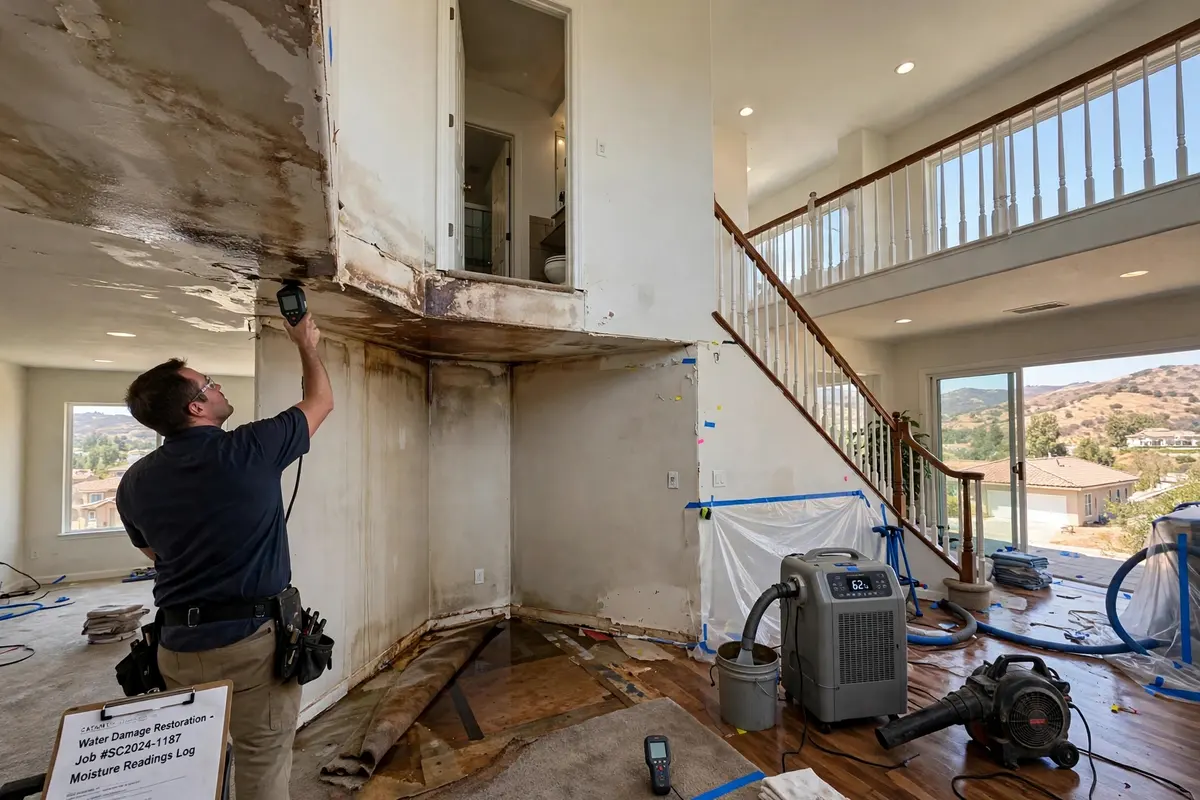
Valencia and Stevenson Ranch Two-Stories
Bathrooms and laundry stacked over living space, slab lines below, and condensate drains in hot attics. The upstairs leak is the local signature.
Old Town Newhall
The valley's first streets: early and postwar homes with aging galvanized and copper, small crawlspaces, and slow in-wall leaks that run quietly.
Canyon Country and the Valley Edges
Tracts against the hills in Saugus and Canyon Country: storm runoff off slopes, retaining walls, and washes that fill fast when a cell sits over the valley.
One thing, stated plainly: Water Damage Pros is a California company, not the service provider that dries your home. The company takes your call and matches it by ZIP code; the independent local contractor who arrives does the work. The company address, phone and email are in the footer of every page.
What Should You Do in the First Hour After Water Gets In?
In Santa Clarita's two-story tracts, the first hour usually starts upstairs and ends downstairs. Work this list in order, and only where it is safe.
Stop the source
When the cause is a pipe or appliance, turn the water off at the main shutoff, usually at the front of the property or next to the garage. In a two-story home, check the upstairs bathrooms first, since a failed supply line there soaks the ceiling below before you see any water downstairs. For hillside runoff, wait for the rain to ease before working near the entry point.
Kill power to wet rooms
If water is close to outlets, appliances or the panel, switch the breaker off for those rooms. Never step into standing water that may be electrified. When the leak is upstairs, switch off the rooms below it as well, since water follows wiring and ducting down.
Photograph everything
Rooms, walls, floors, belongings, and the water line on the wall, upstairs and down. Take the photos before cleanup starts, since insurers pay on records, not memories. Photograph both floors: the bathroom where it started and the ceiling where it showed.
Move what you safely can
Get documents, electronics and furniture legs clear of the water. Check upstairs bathrooms and laundry rooms for drips, and move items from the rooms below them first. Do not throw damaged items away until your insurer has looked at them.
Start extraction fast
Every hour of standing water is more plaster, flooring and framing gone for good. Call (833) 555-0100: an early call gets a local crew moving while damage is still small, and a wet ceiling dried in the first day usually holds.
Why Does Water Keep Finding Santa Clarita Homes?
Because the valley stacks its water. Plumbing sits over living space, lines run under slabs, condensate drains cross hot attics, and a river system that looks harmless eleven months a year crosses the middle of the city. The sources differ; the clues rhyme.
Crews read the same pattern of clues:
- A ceiling stain or bubbling paint below an upstairs bathroom or laundry
- A water bill climbing with no visible leak; the slab is talking
- Drips or a musty smell from the AC closet or attic access in summer
- Paint bubbling at the baseboards of ground-floor interior walls
- Mud lines at garage doors on hillside streets after a hard storm
The split of work matters here. The plumbing, the roof and your lot's drainage are yours and your trades'; the river and the city storm system belong to the city and the county. The restoration crew handles what the water already did once it got in: extraction, disinfection where the water carried contamination, drying to a verified standard, and the repairs. One call to (833) 555-0100 starts that work, and the crew's photos and moisture records are the file your insurer reviews.
Which Water Problems Can One Call Handle in Santa Clarita?
Six kinds of water damage cover almost every Santa Clarita water damage call. Each has its own process and risks.
Water Extraction and Standing Water Removal
Truck-mounted and portable extractors pull standing water out of floors and carpets before drying takes over. The first hours decide the size of the job.
Burst Pipe Water Damage
A supply line lets go and a room takes on water by the gallon per minute. Source stopped, water out, structure dried.
Sewage Backup Cleanup
A sewage backup is a biohazard, not a mopping job. Contaminated materials come out, surfaces are disinfected, and the crew works protected.
Flood and Storm Water Cleanup
Creek and wash overflows, hillside runoff and wind-driven rain bring silt and contamination with them. Pumping out, disinfecting and drying, in that order.
Structural Drying and Dehumidification
Extraction removes the water you can see. Drying removes moisture inside walls, floors and framing, verified by daily meter readings.
Mold After Water Damage
Mold can begin on wet materials within 24 to 48 hours. Fast extraction and verified drying keep a water job from becoming a mold job.
Water Damage Repair in Santa Clarita: Putting the Rooms Back After Drying
Water damage repair in Santa Clarita starts only when the meters say the structure is dry. Repairs put back what drying took out: ceilings, drywall, flooring, cabinets and paint, scoped in writing before work begins.
Santa Clarita repairs turn on the two-story assembly. An upstairs leak makes the ceiling below part of the job: drywall comes down where it soaked, the joists and the upstairs subfloor are verified dry, and the ceiling is rebuilt and matched. In the tracts, the judgment call is the floor over the slab: engineered boards and laminate that swelled come up, tile set on a dried slab can often stay, and open-plan kitchens mean one leak can reach a long run of cabinets, which the written scope should price honestly.
Ceilings, walls and the floor sandwich
Modern tract construction is drywall and engineered framing, which dries and repairs cleanly when the moisture is actually out. The scope should name what was opened, what was dried in place, and what gets rebuilt to match the rooms around it.
The written scope
Repairs should start from a written scope: which rooms, which materials, what gets matched and what gets replaced, agreed before work begins. Kept with the drying records, it is the file your insurer reviews.
Water Damage Cleanup in Santa Clarita Comes Before Any Repair
Nothing gets rebuilt until the rooms are clean: debris out, contaminated material removed, and hard surfaces washed and disinfected. In a two-story home that includes the ceiling cavity the water fell through. Skipping cleanup is how odors and mold get sealed behind fresh work.
One honest expectation: repairs run on the drying schedule. Closing a ceiling over a wet cavity hands you a mold problem with fresh paint on it. Dry first, verified by meter, then rebuild.
How Does the Work Run, From First Call to Fully Dry?
Four steps, in the same order on every job. A crew that skips one leaves damage behind.
Stop the water
The source is shut off or contained, power to wet rooms is made safe, and the damage is photographed before anything moves.
Extract
Standing water comes out with truck-mounted and portable extractors. Wet materials are checked one by one: what can dry in place, what has to come out.
Dry
Air movers and dehumidifiers run for days, not hours. Readings are taken daily against a dry standard; equipment comes out only when the numbers say dry.
Restore
Plaster, drywall, flooring, trim and paint go back in. The final walkthrough checks the finished work against the written scope.
Does Homeowners Insurance Cover Water Damage in Santa Clarita?
Usually, when the water is sudden and accidental. The pattern across California policies looks like this:
Usually covered
Damage from a pipe that bursts suddenly, a failed water heater or a split supply line: extraction, structural drying, and repair of soaked plaster, floors and cabinets. The crew's moisture records and photos become part of your claim.
Usually not covered
Replacing the worn-out pipe itself, slow corrosion leaks that ran for months, maintenance failures, and rising water from outside, which needs its own flood policy. Many policies also cap mold work, so a water job left wet becomes a mold bill the policy barely touches.
The Santa Clarita trap is the wash. Many valley homes sit near the Santa Clara River, Bouquet Creek or a neighborhood wash but outside the mapped high-risk flood zones, so owners reasonably assume flood is not their problem. Standard policies still exclude surface water wherever the home sits, and a separate flood policy is the only cover for it; those policies usually take 30 days to take effect, so the time to buy one is before storm season, not during it.
Do not wait for an adjuster before starting extraction and drying. Policies carry a duty to limit further damage, and claims are decided on the cause of the water, not on whether you protected the home quickly. Keep every record the crew gives you.
What Happens When an Upstairs Bathroom Leaks in a Two-Story Santa Clarita Home?
It is the valley's signature water job, and it behaves differently from a ground-floor leak: gravity does the spreading, and the room that suffers most is the one below.
Gravity writes the damage map
Upstairs water does not pool where it escapes. It runs along the subfloor, follows the joists, and drops through the ceiling assembly at low points and seams, so the stain can appear rooms away from the failed fitting. A toilet seal leak wets the floor ring and the ceiling in a slow circle; a supply line sprays inside the wall until the baseboard downstairs swells. The crew's moisture map, not the stain, defines the job.
The ceiling below is the first witness
Homeowners almost always meet this leak as a ceiling stain, a bubble in the paint, or a drip through a light fitting. The order matters: stop using the bathroom, shut its water off, and photograph everything before anyone cuts. The cause has to be identified and documented first, because the insurer pays on the cause, and a ceiling opened in a hurry destroys the evidence of which fitting failed.
Drying the floor-and-ceiling sandwich
The assembly between the floors is dried from both faces: air movement and dehumidification upstairs, directed drying or a careful ceiling opening below. Readings are taken in the joists and the subfloor, not just on the visible surfaces, because the middle of the sandwich dries last. Where the ceiling drywall has soaked through or sagged, it comes out and is rebuilt; where readings come back to standard, it stays.
Santa Clarita: The City Behind the Calls
Santa Clarita is one of the youngest cities in California, formed in 1987 from four valley communities, and already the third largest city in the county, home to about 229,000 people. It is a valley of master-planned tracts and old ranch towns at 1,200 to 1,400 feet, and its water damage splits the same way: new two-story homes above, old pipes below.
The Weather: Hot Summers, Concentrated Winters
Santa Clarita averages about 15 to 18 inches of rain a year, nearly all of it between November and March, with February the wettest month. Summers are long, dry, and hot, with highs in the 90s and peaks over 100, while winter nights can drop into the 30s. The valley sits higher than the basin below, so it runs hotter in summer and cooler in winter, and the rain, when it comes, falls on hillsides left dry for months: runoff gathers in the washes and creeks, and the Santa Clara River, usually a dry sandy bed, can run bank to bank in a big storm.
When Water Damage Peaks in Santa Clarita
Winter, December through March, is the peak season. The first heavy rain finds roof leaks in the two-story tracts, and the storms that follow push runoff down hillsides and into the washes, the creeks, and the lower rooms of homes near them. February, the wettest month, is usually the busiest month of the year for storm calls.
Summer brings the other pattern: air conditioning condensate lines clogging in the long heat, upstairs bathrooms and laundry rooms leaking down into living rooms, and slab leaks that show up in every month, because they come from pressure and aging lines, not weather. The quietest stretch is usually late spring, April and May, between the last winter storm and the first heat wave.
The History: Four Towns Become One City
The Tataviam people lived in this valley for centuries before Europeans arrived, and the Portolá expedition passed through in 1769. The land later became Rancho San Francisco, and in the 1800s the towns of Newhall and Saugus grew up along the Newhall Pass corridor, joined in the 1960s by the master-planned community of Valencia and by Canyon Country. After decades of attempts, the valley voted to incorporate, and on December 15, 1987, the City of Santa Clarita was formed from the four communities, the largest city incorporation in California's history at the time. The film industry has worked here for a century, drawn by the valley's ranches and western towns. That young history is why most of the city's homes, and most of its plumbing, date from the 1960s onward, with the oldest lines in Old Town Newhall.
The City at a Glance
Santa Clarita covers about 62 square miles and is home to about 229,000 people, the third largest city in the county. It sits about 30 miles northwest of downtown LA, in a valley crossed by the Santa Clara River and ringed by the San Gabriel Mountains. Three Metrolink stations link the valley to the rest of the region, and the city's economy runs on film and television production, healthcare, and the retail and services of a fast-growing suburb. For a homeowner, the practical fact is the mix: a 1960s ranch in Newhall and a two-story tract in Valencia face different water risks, which is why matching runs by ZIP code, not by city name.
Questions Santa Clarita Homeowners Ask After Water Damage
How fast can a crew get to my Santa Clarita home?
Crews are matched by ZIP code, and Santa Clarita coverage is compact: 6 covered ZIP codes across one valley, so the crew heading to you is already local. Most calls get a crew the same day, often within hours, and timing for your ZIP code is stated honestly on the call.
There is a stain spreading on my ceiling below the upstairs bathroom. What now?
Stop using that bathroom and shut its water off if you can isolate it, then photograph the stain and call. The usual causes are a failed supply line, a leaking drain, a toilet wax seal, or a tub or shower that has been spilling over its edge for weeks. The crew meters the ceiling and the floor above, finds which one it is, and dries or opens the assembly before the framing stays wet long enough to grow mold.
What are the signs of a slab leak in a Santa Clarita tract home?
A water bill that climbs with no visible leak, the sound of water running when every tap is closed, a warm spot on a hard floor, carpet that feels damp in one patch, and paint bubbling at the base of interior walls. The lines run under the slab, so the wettest room is often not the room over the leak; the crew maps the moisture before anyone opens the floor.
Does homeowners insurance cover water that came in from a wash or the Santa Clara River?
Usually not under a standard policy. Water that flows over the ground and in through a door is classed as surface water, which standard policies exclude; a separate flood policy covers it. The local trap is that many valley homes sit near washes and creeks but outside the mapped high-risk flood zones, so owners assume they have no flood exposure. The creek does not read the map.
Can we stay in the home while the drying equipment runs?
Usually, yes, on a clean-water job. The wet rooms are closed off and the equipment is loud, but the rest of the house stays livable, and in a two-story home the unaffected floor often carries on as normal. Contaminated water is different: those rooms stay sealed until disinfection is verified, and the crew will tell you plainly which case you have.
How long does drying take in a two-story Santa Clarita home?
Most homes run 3 to 5 days of structural drying. A floor-and-ceiling assembly dries slower than an open room because both faces have to be dried and read, and slab neighborhoods add the concrete's own slow schedule. The crew takes meter readings daily, and equipment leaves when the numbers match a dry standard, not when a set number of days has passed.
Which Santa Clarita Neighborhoods and ZIP Codes Are Covered?
Matching is done by ZIP code. This guide covers the city of Santa Clarita: 6 ZIP codes, from Old Town Newhall to the newest Valencia tracts:
All 6 covered city ZIP codes:
Just outside the list but still in Santa Clarita? Call anyway. Matching runs on the ZIP code of the home, and the closest crew takes the job.
Water in the House Right Now?
Shut the water off at the main, keep clear of electrical hazards, and take photos before anything moves. Then make the one call that starts your Santa Clarita water damage restoration job with a local crew: extraction first, meter-checked drying behind it, and a written scope first.